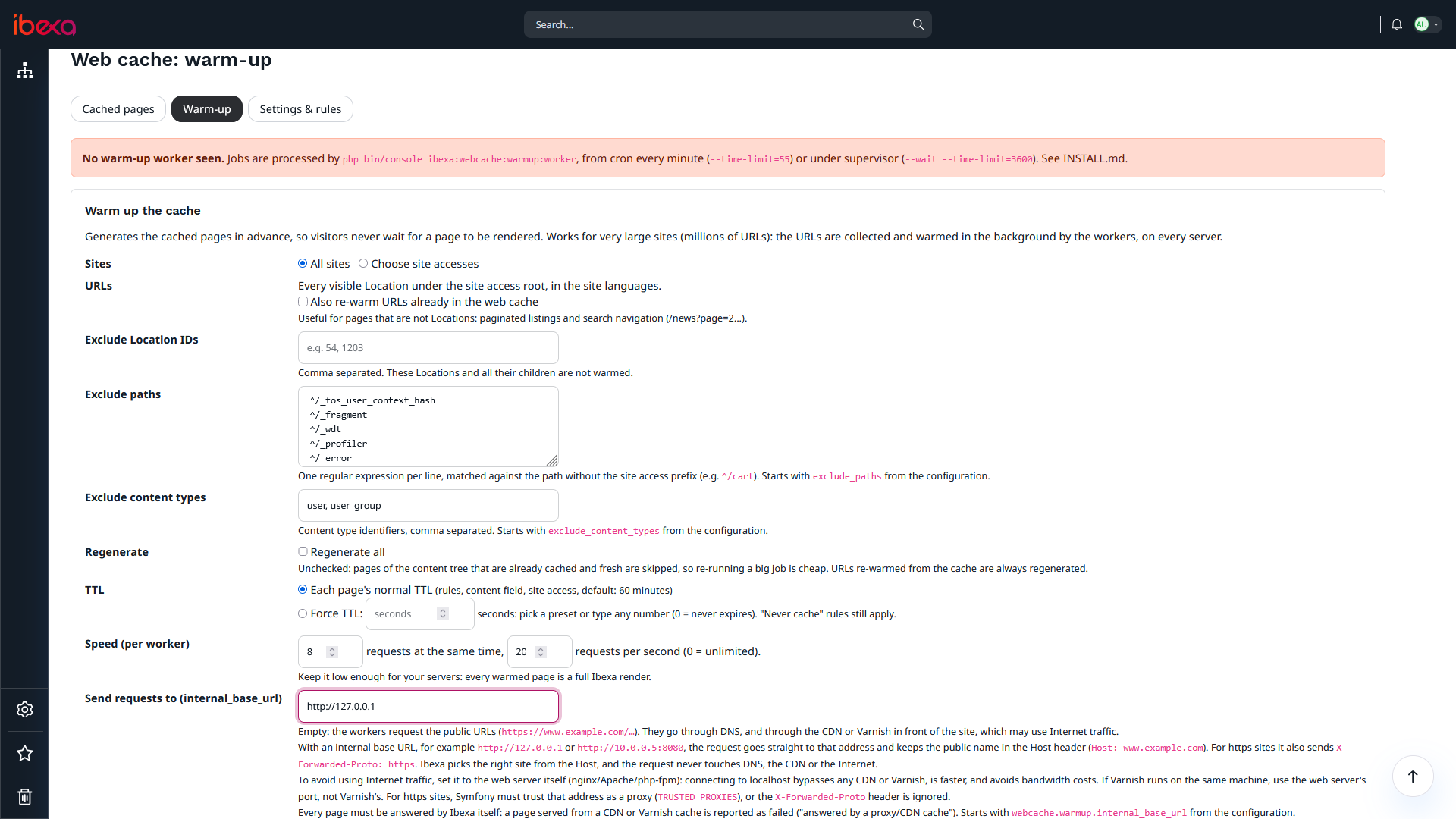
Show cache warmup features, indexing 300+ URL out of 933 in 18 seconds
Installation of v. 1.11.0
Demo showing how when data is Published (edited), the cache for the elements using that content, are cleared from cache. And some of them are recreated automatically in the cache
Webcache Enterprise for Ibexa 4.6 and 5.0
저자 Carles Mateo
 Ibexa
Ibexa Cache
Cache
Cache Variations
CDN
Geolocation
Ibexa
Ibexa 4
Ibexa 5
OSS
Performance
Server Side Tracking
Enterprise Cluster edition. A high-perfomance cache engine that runs in the origin (your servers) and caches the HTML pages in Redis (memory) or shared disk when they are generated, and serves next requests super-fast. Clears cache automatically when new content is published or expires it by TTL, and integrates seamlessly with Varnish, Cloudflare, Fastly. Multi Site Access (multi-domain), Multi Language support. Protects from "cache stampede" when many requests come at once for the content that just expired
WebCache for Ibexa 4.6 and 5.0
Full-page cache features for Ibexa DXP 4.6 and 5.0: faster pages, lighter servers, content that is always up to date.
WebCache for Ibexa stores the finished HTML of your public pages and serves it to the next visitors in milliseconds, without running the full Ibexa stack again. When an editor publishes, every page showing that content is cleared and the new version is generated at once. Your visitors get speed, and your editors never have to think about the cache.
It works with every edition and every 4.6.x release of Ibexa DXP (OSS, Headless, Experience and Commerce), and every edition of Ibexa 5.0, on a single server or a cluster (Up to 10 nodes), for one site or many.
Use cases
- Your site has heavy pages, slow to render live because of plugins (like WYSYWIG editors). Cache the final render and serve the pages super fast every time.
- You have customized code that communicate to external APIs to render the pages, with responses that can be cached, and the response from the APIs is slow. Cache the resulting rendered pages and serve them in milliseconds afterwards.
- You have 50 editors and they are generating load by browsing public pages (The CDN lets them in to Origin cause they have the session cookie). Web Cache knows what content is public and shows it from cache.
- You have logged in users or logged out browing public pages but the CDN lets them in to Origin cause the have the session cookie, and so they see slow pages. Same.
- Your pages do some heavy computation on every request to Origin (like checking if files exists or lazy generating image variations from the page body).
- Your page takes more than one second to be served (with or without CDN) and you want it to be delivered super fast.
- You want to know what requests are getting to Origin and investigate why.
- You want your pages to be always warm-up in the cache and ready to be sent super-fast.
- You have huge marketing campaign, with requests with parameters that get to Origin, and cause seconds of computation.
- Your paginated pages load slow. Warm-up them with Web Cache and have them ready to be served.
- You serve content based on geolocation that is hard to compute. Warm-up the continent variants with Web Cache, at your desired times of the day.
Why WebCache for Ibexa
- Pages in milliseconds. Cached pages are answered before Ibexa routing, security and the content repository even start.
- Lower hosting costs. Far less PHP, database and search-engine work per visit, so the same servers handle much more traffic.
- Always fresh after publishing. Publishing clears the content's own page and every page that shows it: section listings, home page teasers, menus and embeds, on every site and in every language. The content's pages are then rebuilt straight away.
- Editors stay in control. A cache manager in the Ibexa back office shows every cached page, and lets editors clear it or mark it "never cache" with one click.
- Built for multi-site and multilingual. Supports 10 or more domains and all your languages. Each site and language has its own cache entries.
- Ready for clusters. Several Ibexa servers share one cache through Redis or a shared disk, and a change made on one server applies to all of them.
- Safe under traffic peaks. When a popular page expires, only one request rebuilds it. Every other visitor gets the previous copy or waits a moment, so expiry never causes a load spike.
- Plays well with your CDN. Works alone or in front of Varnish, Fastly or Cloudflare, and keeps the cache tags they use for purging.
Features
Storage of your choice- Redis: set the server and port (password, database and Sentinel supported).
- Disk: set a folder, either local or a shared mount (NFS, EFS…) for several servers.
- Pages are compressed and written atomically, so nobody ever sees a half-written page.
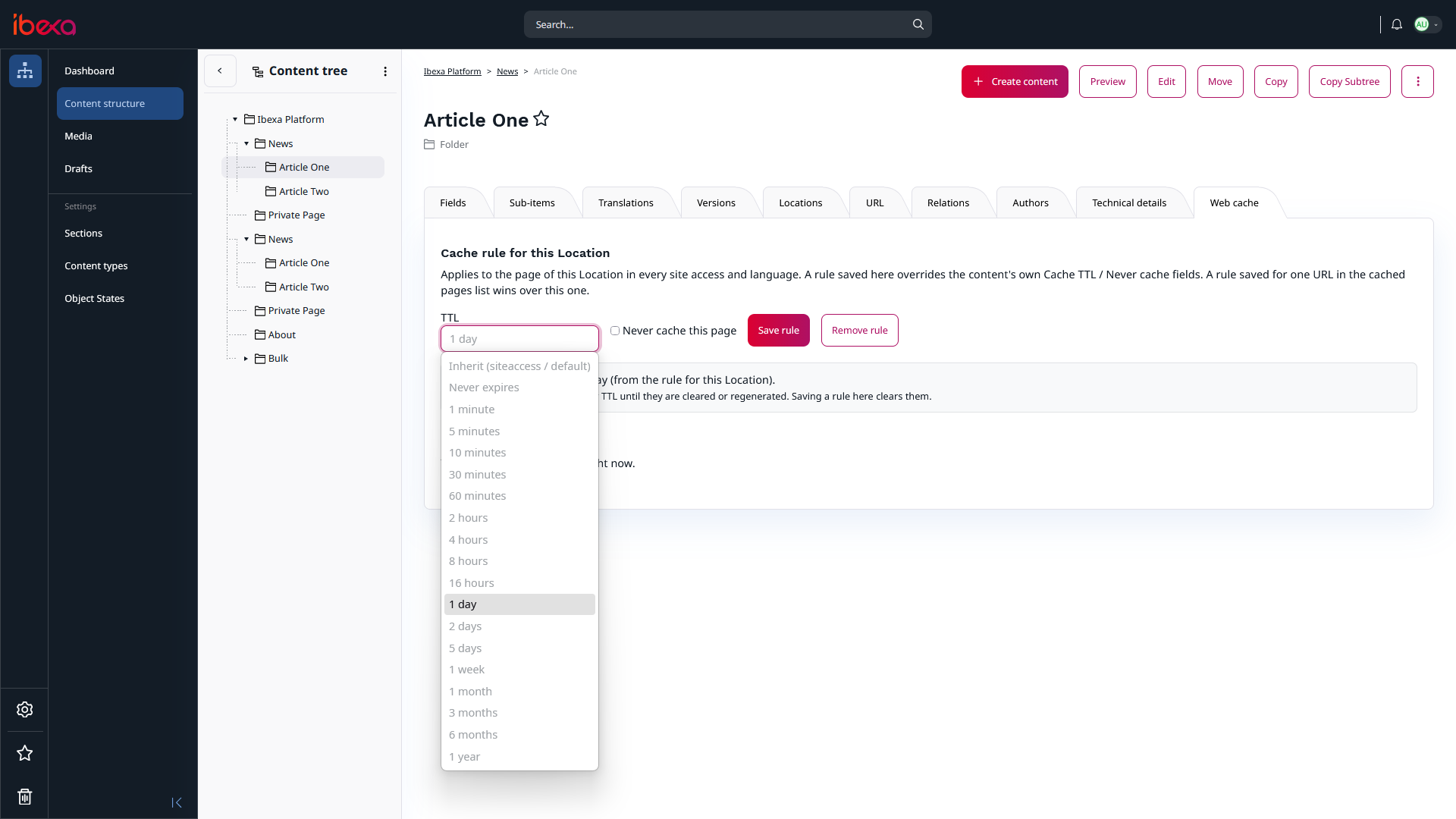
- Default TTL from the back office: Never expires, 10 minutes, 60 minutes, 1 day, 1 week, 1 month, 1 year...
- A different TTL per site (siteaccess).
- A different TTL per location, and you can make it inherit for all the children (useful for multi sites, to set the global TTL for a site and their children pages)
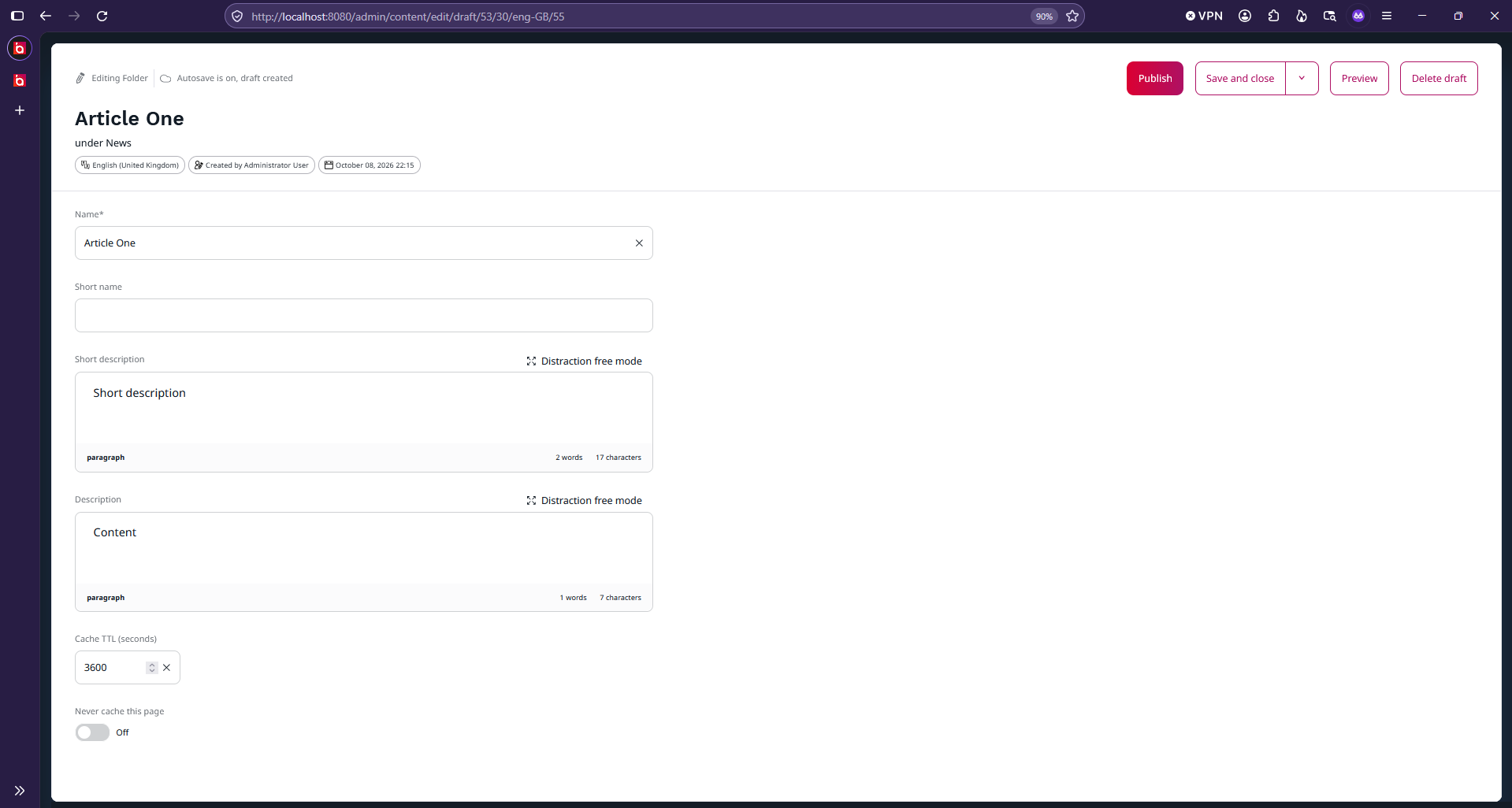
- A different TTL per page, from the back office or from a simple "Cache TTL" field in the content form.
- When a page expires, the next visit rebuilds it automatically.
Cache Variations (or Variants)
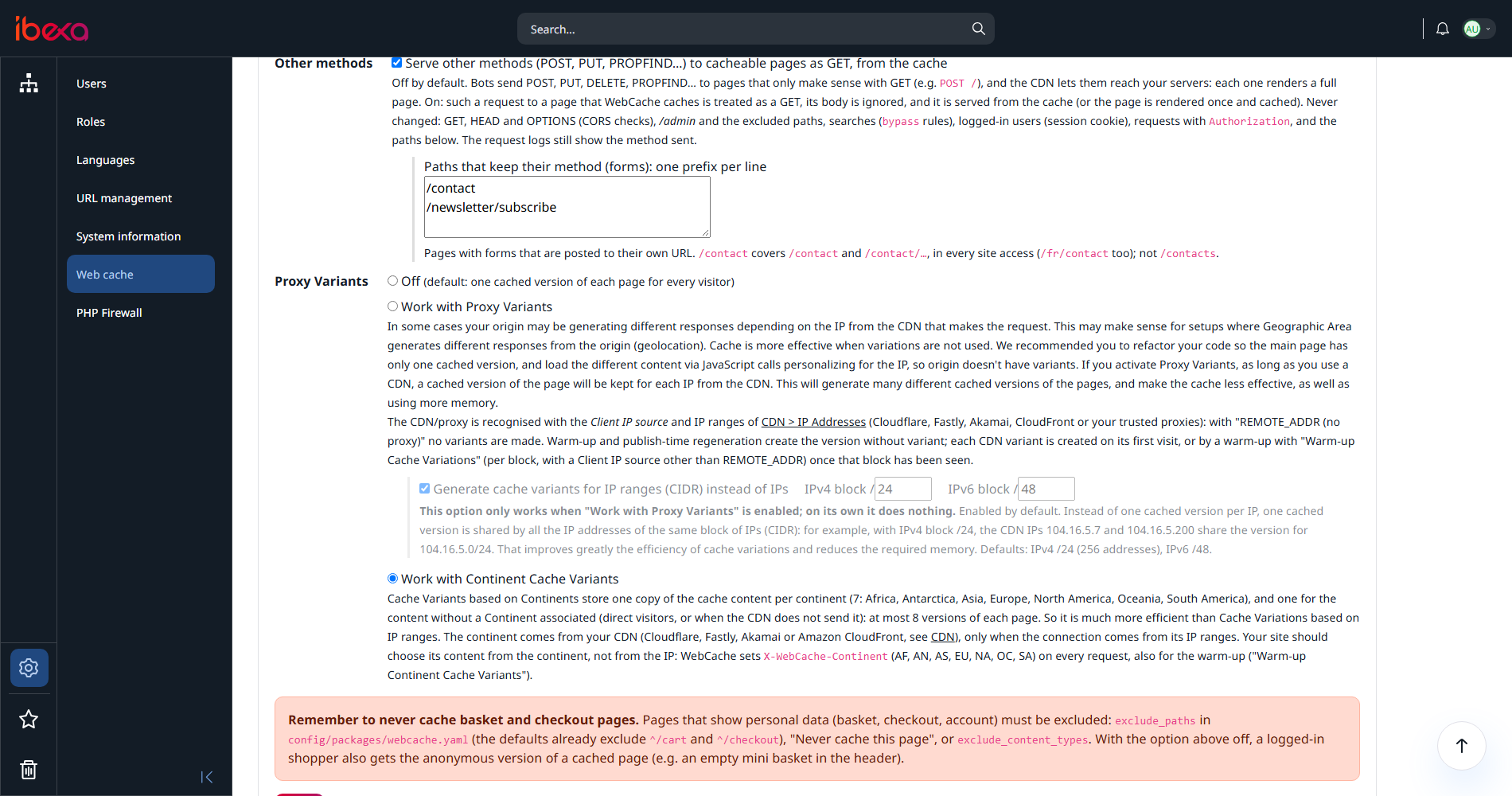
- When you need to generate different cached responses for the same pages, depending on the geolocation from the IP of the visitor
- Continent Cache Variations, will keep and warm-up cache variations for the 7 Continents, plus for non-Continent version.
- Works with Fastly, Cloudflare, Cloudfront, Akamai and with your own proxy configuration based in Varnish, nginx or a Custom Heather
- Cloudfront provides geolocation by country, not Continent. Carles Mateo's WebCache handles it transparently for Cloudfront.
- Optimised mode to generate Cache Variations based on network range (CIDR), not on the many IPs of the CDN (it groups the IPs into networks, saving memory and generating higher cache hit ratio) for other CDNs with less IPs/Network ranges.
Cache ESI and non ESI variants
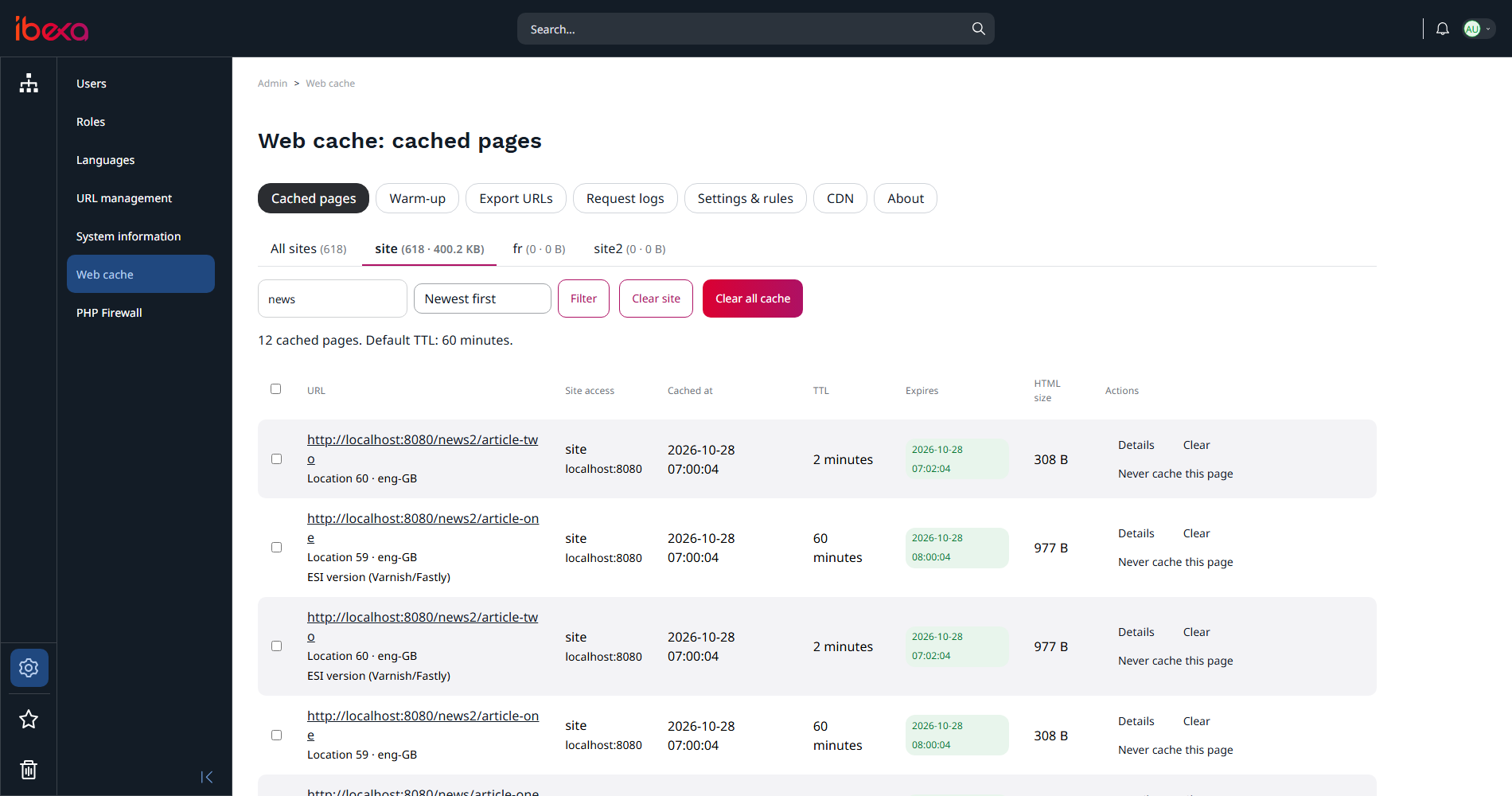
ESI support for pages with render_esi() behind Varnish or Fastly with ESI.
A page has two cached versions:
- The ESI version, for requests that can assemble ESI (Surrogate-Capability with ESI/1.0, as Ibexa's Varnish VCL sends): it holds the <esi:include> tags and keeps Surrogate-Control: content="ESI/1.0", so Varnish/Fastly assemble it on every hit, and the fragments stay cached by Varnish/Fastly with their own TTLs;
- The plain version, for everybody else (direct requests, the warm-up through internal_base_url): the fragments are rendered inline.
- Warm-up: also warm the ESI version (console --esi, also with --url). The ESI version is signed like the Proxy Variants (a visitor cannot ask for it), and the warm-up tells Symfony which version to render whatever proxy the request goes through.
Warm-up cache
- Warm-up cache for all the sites, or a single site, one or more languages
- Runs in parallel, from admin page, or from command line. Can specify the level of parallel work to prevent overload the server
- Able to warm-up giant sites with millions of cached URLs, and Continent Cache Variants
- Fast, synchronous, admin web cache, for small sites with few hundreds of URLs
- Supports also Cache Variations (Continent, IP ranges (CIDR) or IPs already in the Cache)
- Option to warm-up navigation search/pages with navigation, up to max_pages
- Trigger warm-up from the admin interface, of from cron jobs or Command line
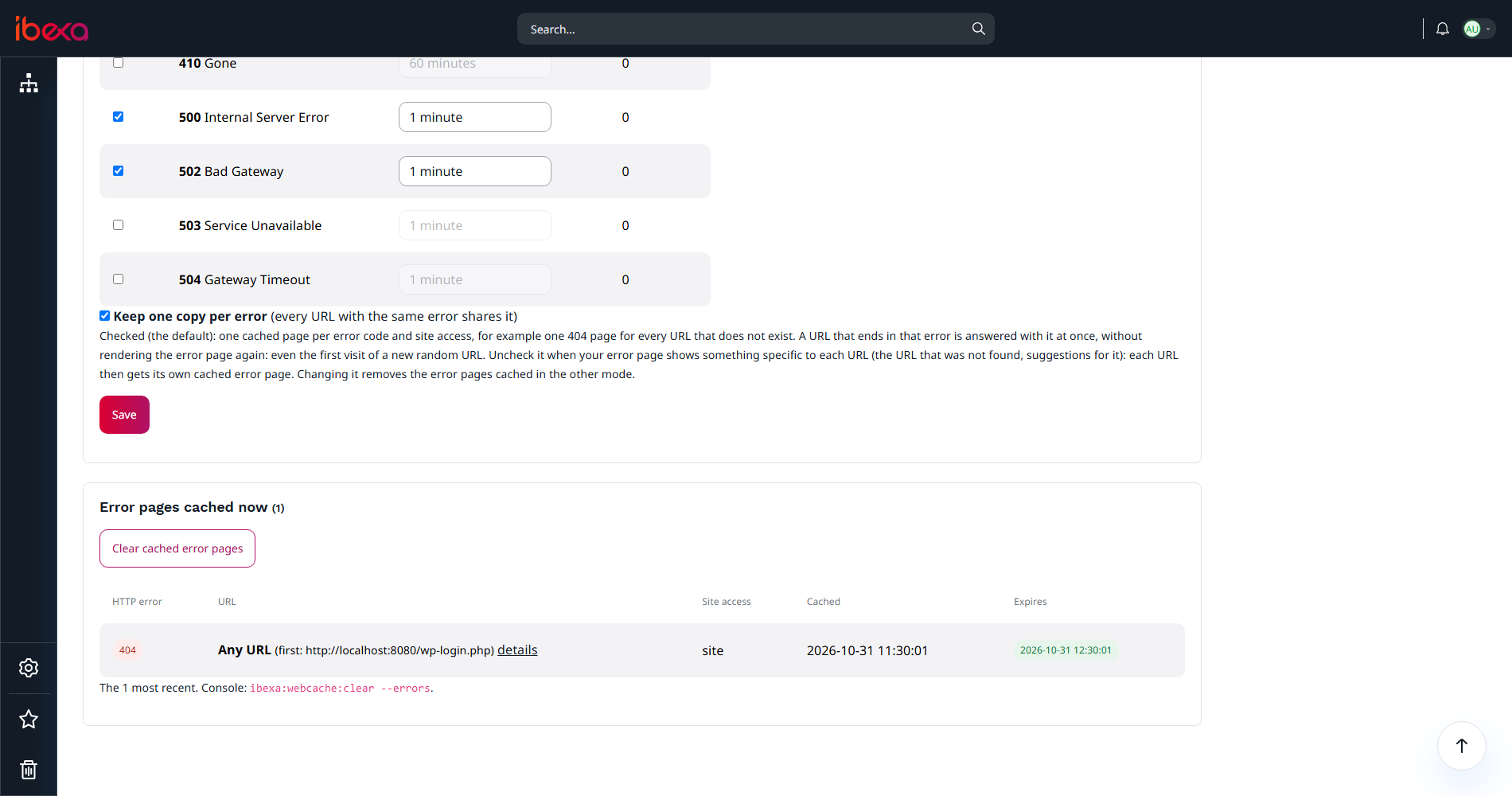
Cache errors
Optionally cache error pages.
Cache each page individually, or cache one single common page for errors.
Configure the different kind of errors, with their own TTL.
In these times of bots requesting random pages, caching 404 can save a lot of resources from your servers.
Exactly the right pages are cached
- Only public pages for anonymous visitors (GET) are cached. Logged-in users, personal pages and form submissions (POST) are never cached.
- Login, user profile, cart, checkout and API URLs are excluded out of the box, and you can add your own.
- "Never cache this page" can be set with one click from the cache manager, per URL or for a page in all sites. It can also be a checkbox in the content form.
- Extra URL parameters such as ?utm_source=… or ?test=1 are ignored, so they don't create duplicates.
- Search pages are never served from the cache (rule included in the supplied configuration). Paginated listings (?page=2) can be cached page by page and are refreshed when new content is published.
Back office cache manager
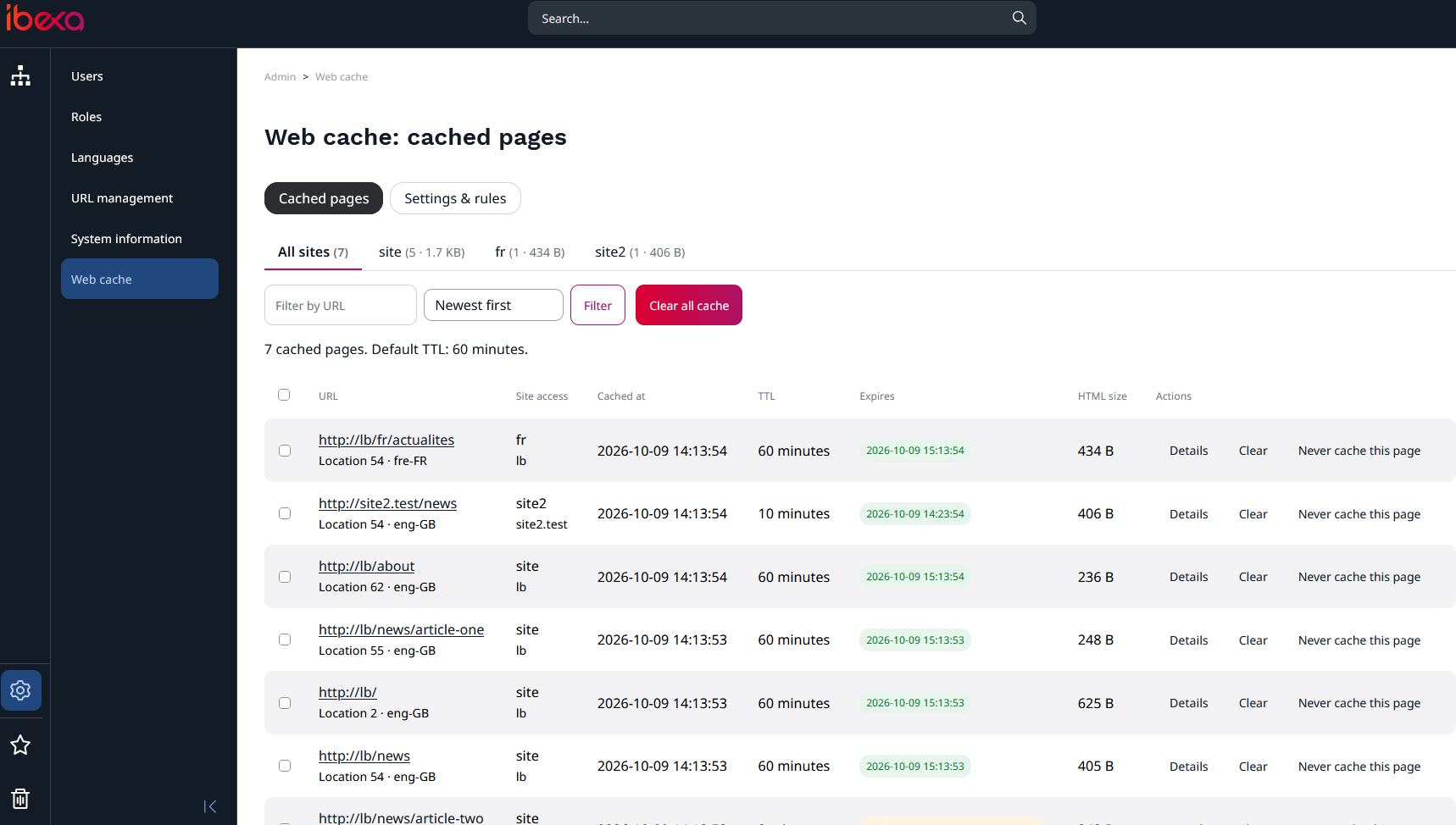
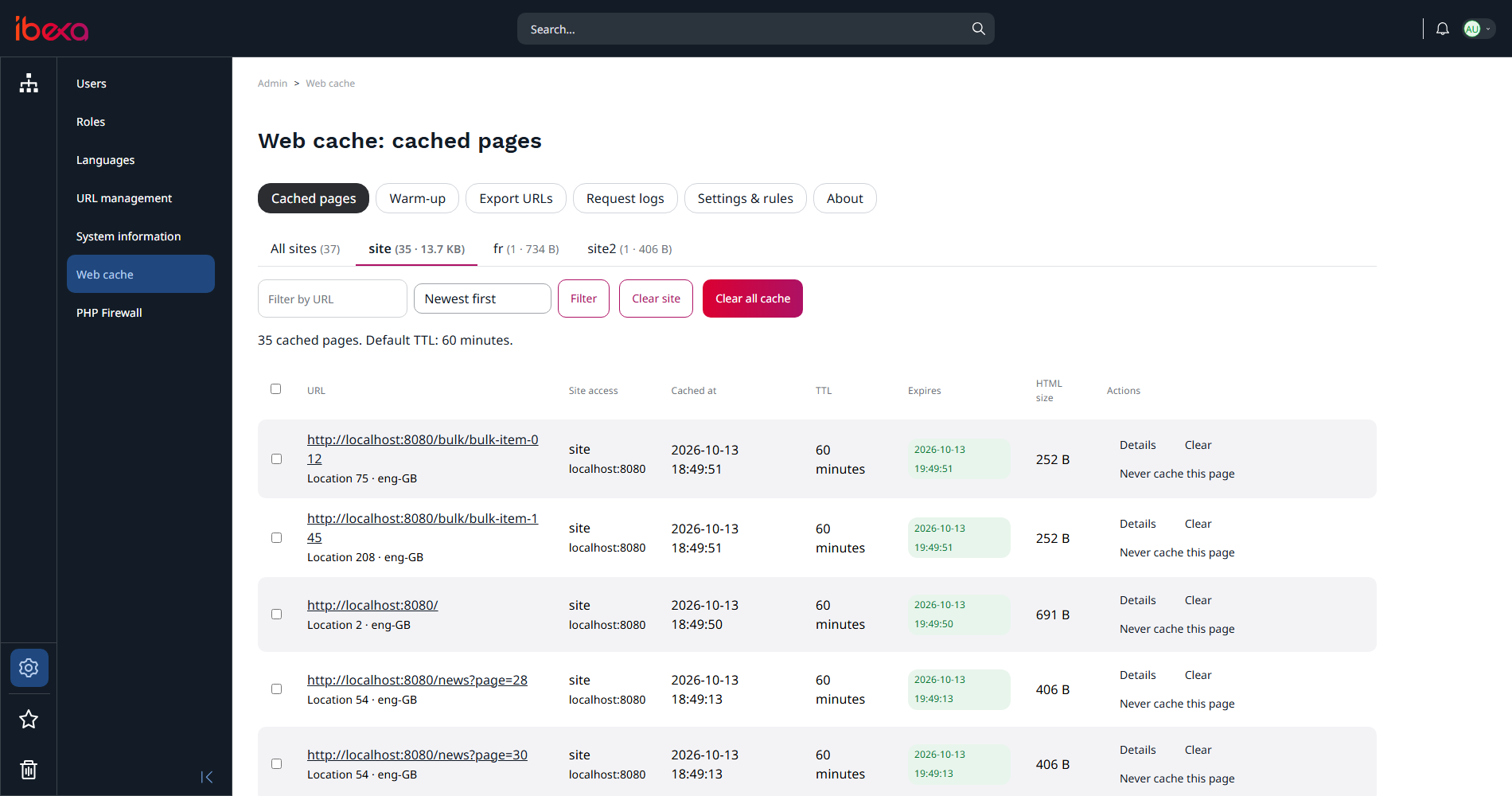
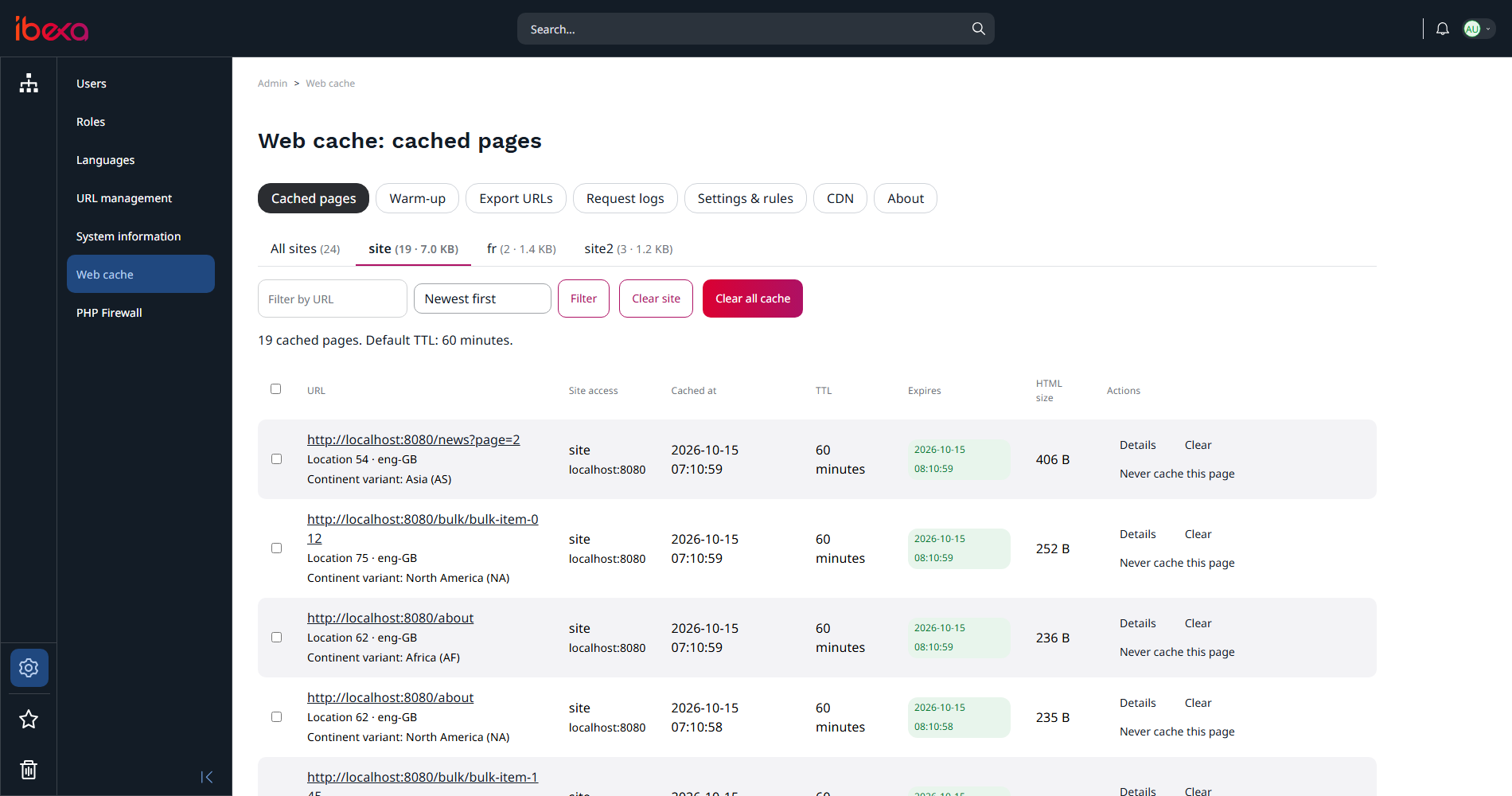
In Admin > Web cache:- All cached pages, grouped by site (domain/siteaccess), with the number of pages and total size per site.
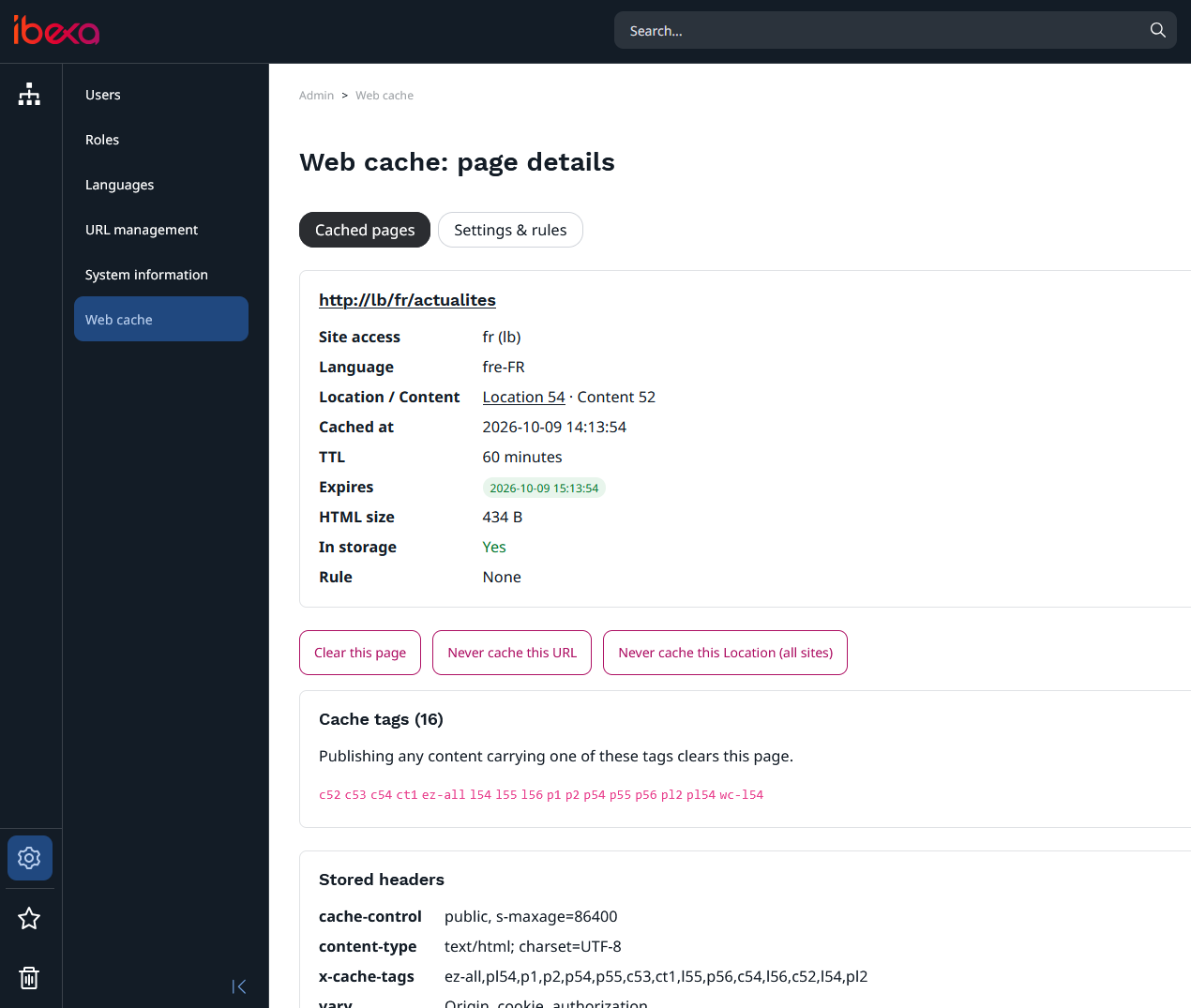
- For each page: URL, date and time it was cached, TTL, expiry date and HTML size. It also shows the content it belongs to, its cache tags and the stored headers.
- Clear one page, a selection, a whole site, or everything.
- Never cache this page in one click.
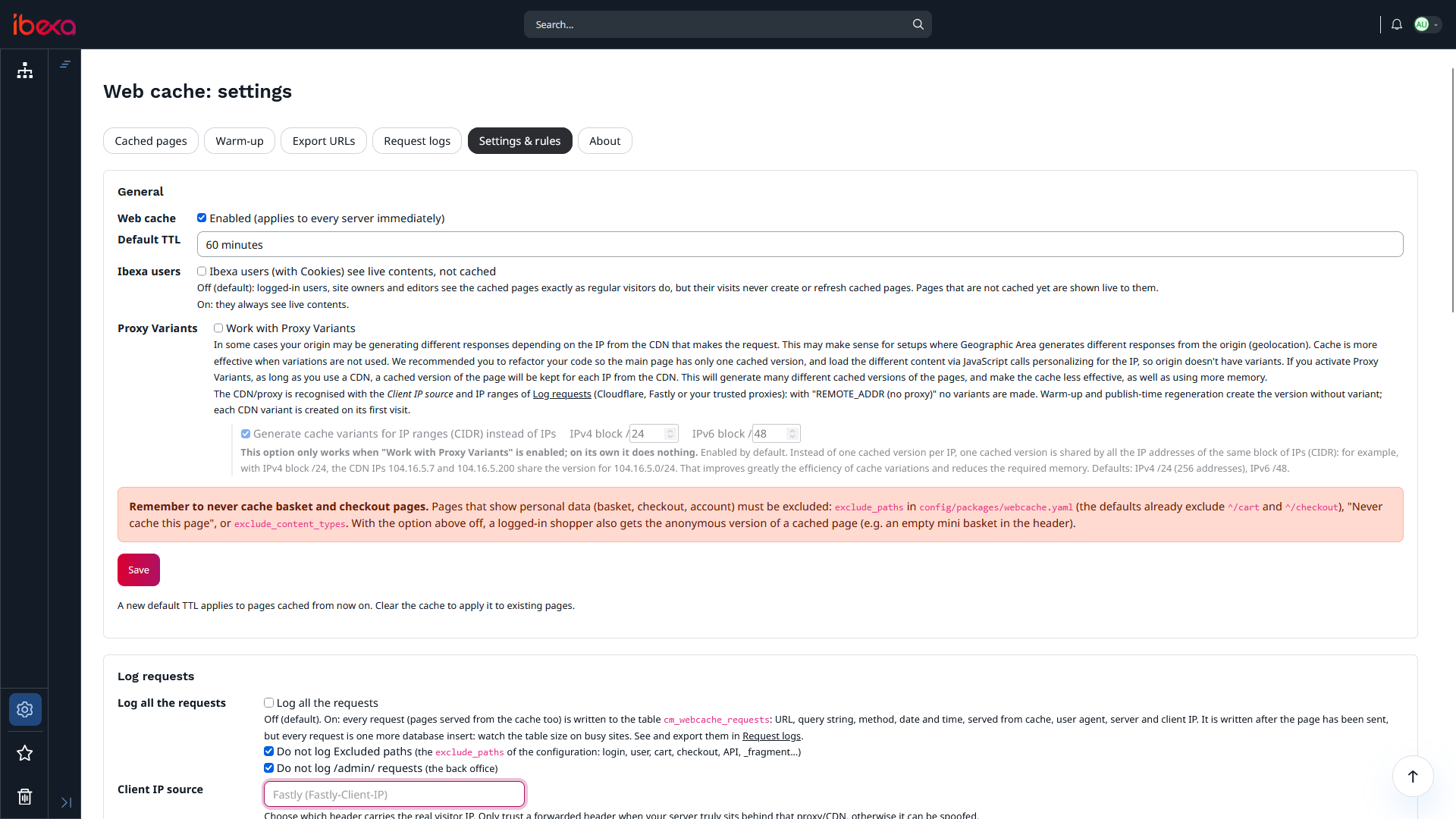
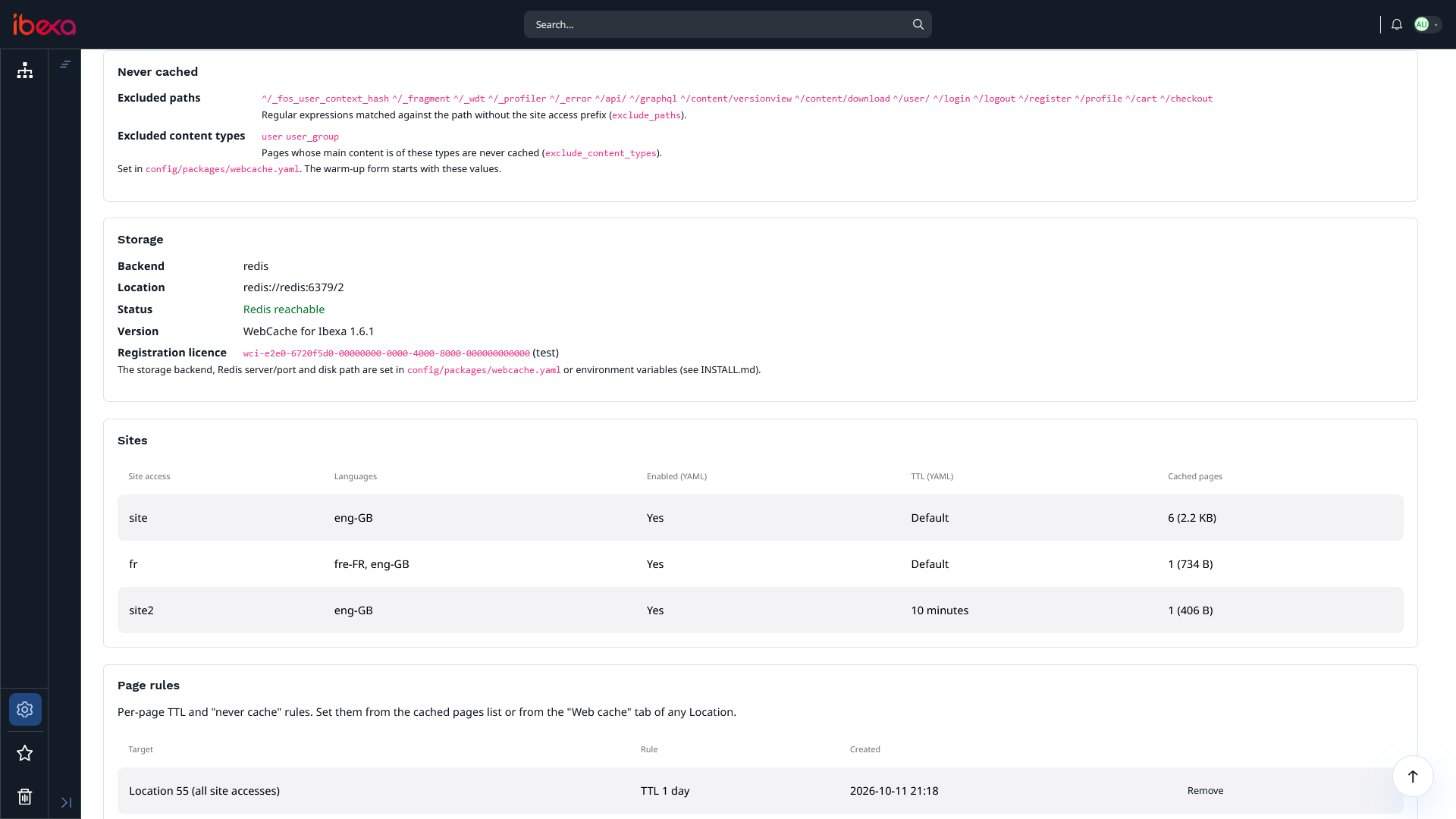
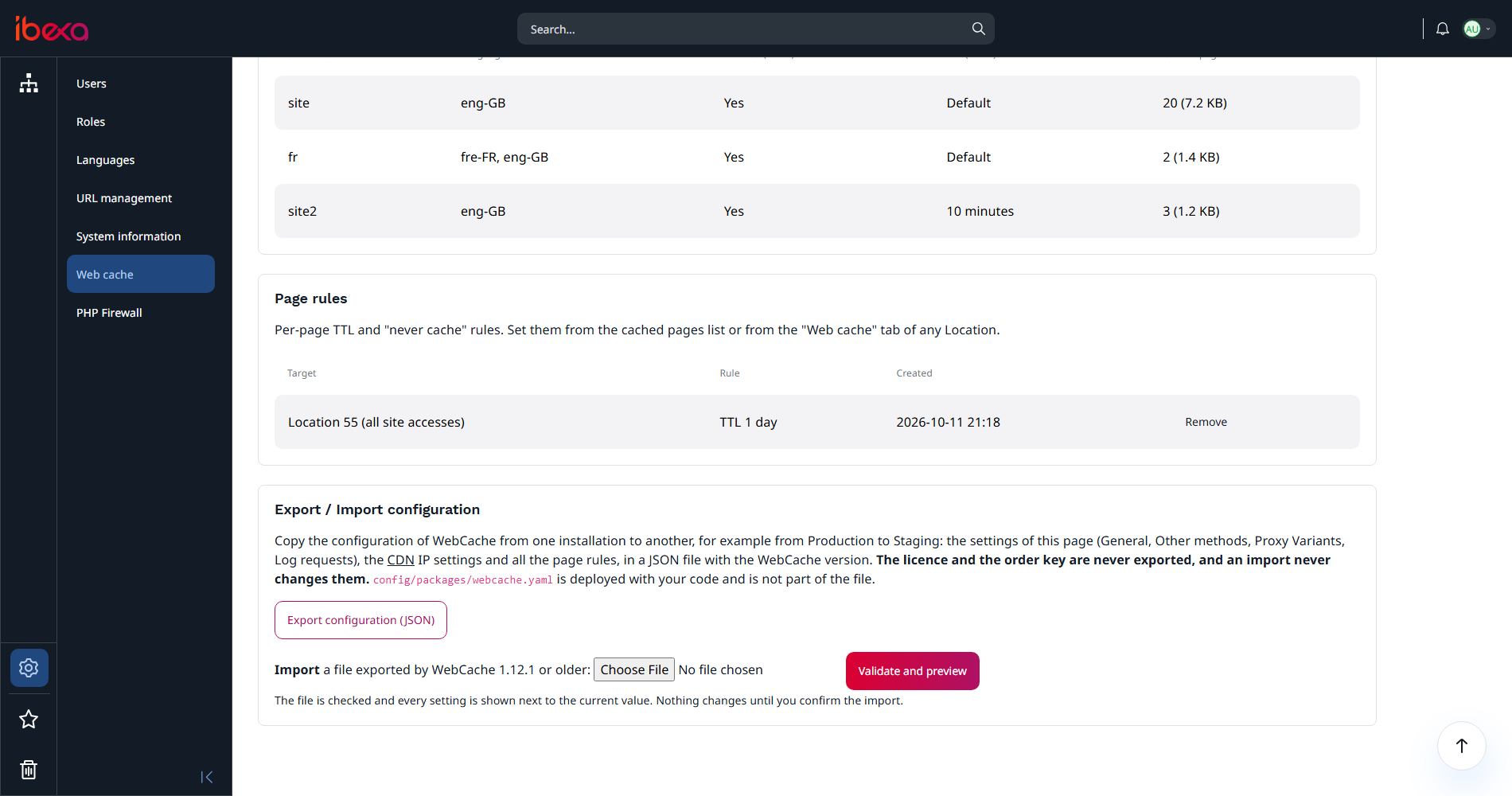
- Settings page: enable or disable the cache, the default TTL, a storage health check, and the list of page rules.
- A Web cache tab on every content item shows its cached URLs and lets editors set its TTL or turn its caching off.
- Permissions (view / clear / configure) are assigned to roles like any other Ibexa permission.
Check the difference
A Tests section allows to set an artificial delay to not cached pages for 1 hours so you can test and compare.Set 1 second, 5 seconds, 10 seconds, 15 or 30, artificial delay on not cached pages (admin is excluded) and compare the ultra fast browsing with the cached pages.
For developers and operations
- Console tools to install, check status, clear (all, by site, URL, content or tag), clean up, and pre-load pages (for example from a sitemap).
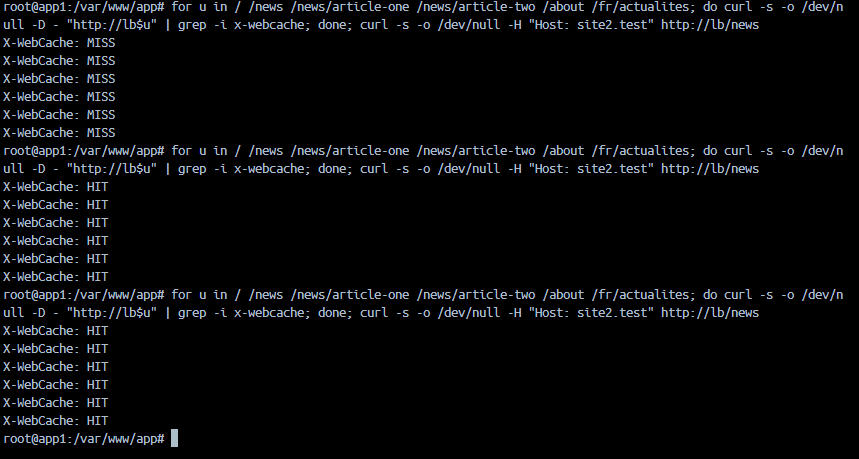
- An X-WebCache response header (HIT, MISS, STALE, or the reason a page was not cached) makes diagnosis easy.
- Optional background regeneration with Symfony Messenger workers.
- The site keeps working even if the cache storage goes down.
How it works
- A visitor asks for a page. If a fresh copy is in the cache, it is sent immediately.
- Not cached yet, or expired? Ibexa renders the page once, and WebCache stores it for the next visitors. Only one request does this work, even under heavy traffic.
- An editor publishes. WebCache clears every page that shows the content, on every site, and rebuilds the content's pages right away. CDN purges keep working as before.
Bot variable requests
Nowadays, that bots generate more traffic than humans, many bots try many variations with parameters like:
/?test=1
/?test=2
/?test=3
/?test=random
/?other=things&and=requests
In many cache solutions this is a problem, and all the requests arrive to the origin (the backend server) as if they were different pages, consuming valuable resources and.
In WebCache (except in search pages where it makes sense), these extra parameters are ignored and served as if they had not the parameters. So in this example case all the requests are cached as for page / and displayed immediately. However all the requests, with the parameters, can be logged and exported as CSV for Server Side Tracking.
Bot Method requests
Many bots try random things like sending POST to your pages, generating heavy load on the servers.
In many CDN setups, POST and other verbs different from GET/HEAD/OPTIONS is allowed to be sent to origin, and so, your server (origin) has to deal with the avalanche of requests.
Carles Mateo's Web Cache for Ibexa protects your site from undesired Method requests, and serves the content from cache. Enable or disable the option, and customise the paths you want to enable POST and other verbs, like i.e. /contact
What load will my servers be able to serve with Webcache?
An amazing massive number of page requests can be served with just a single server.
You won't believe how fast your servers serve the pages, and how great your user's experience becomes by using this software until you try it.
CDN support
Web Cache for Ibexa support these CDNs (and the geolocation they provide):
- Akamai
- Cloudfront
- Cloudflare
- Fastly
Also your own and nginx and Varnish.
Supports ESI.
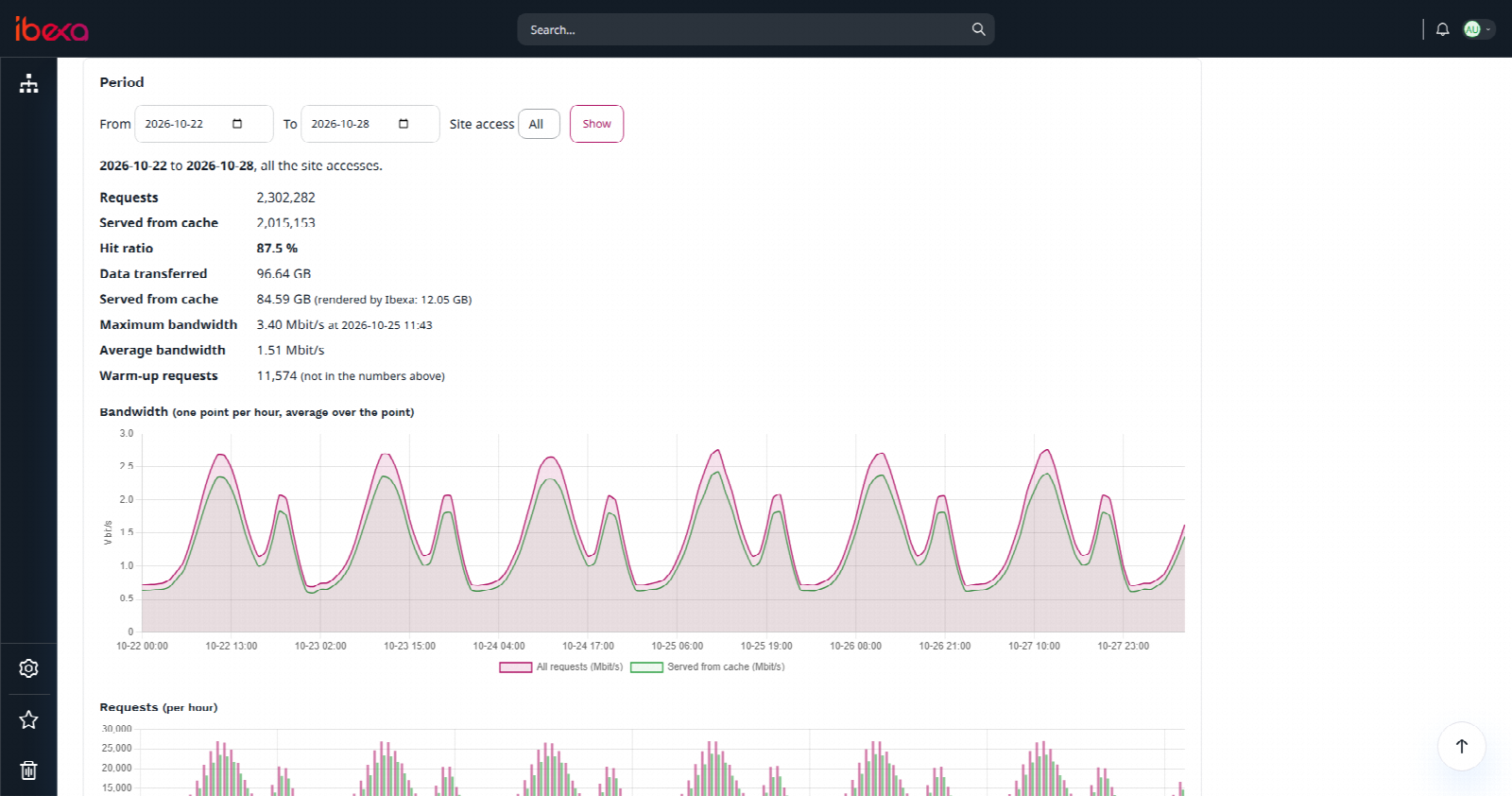
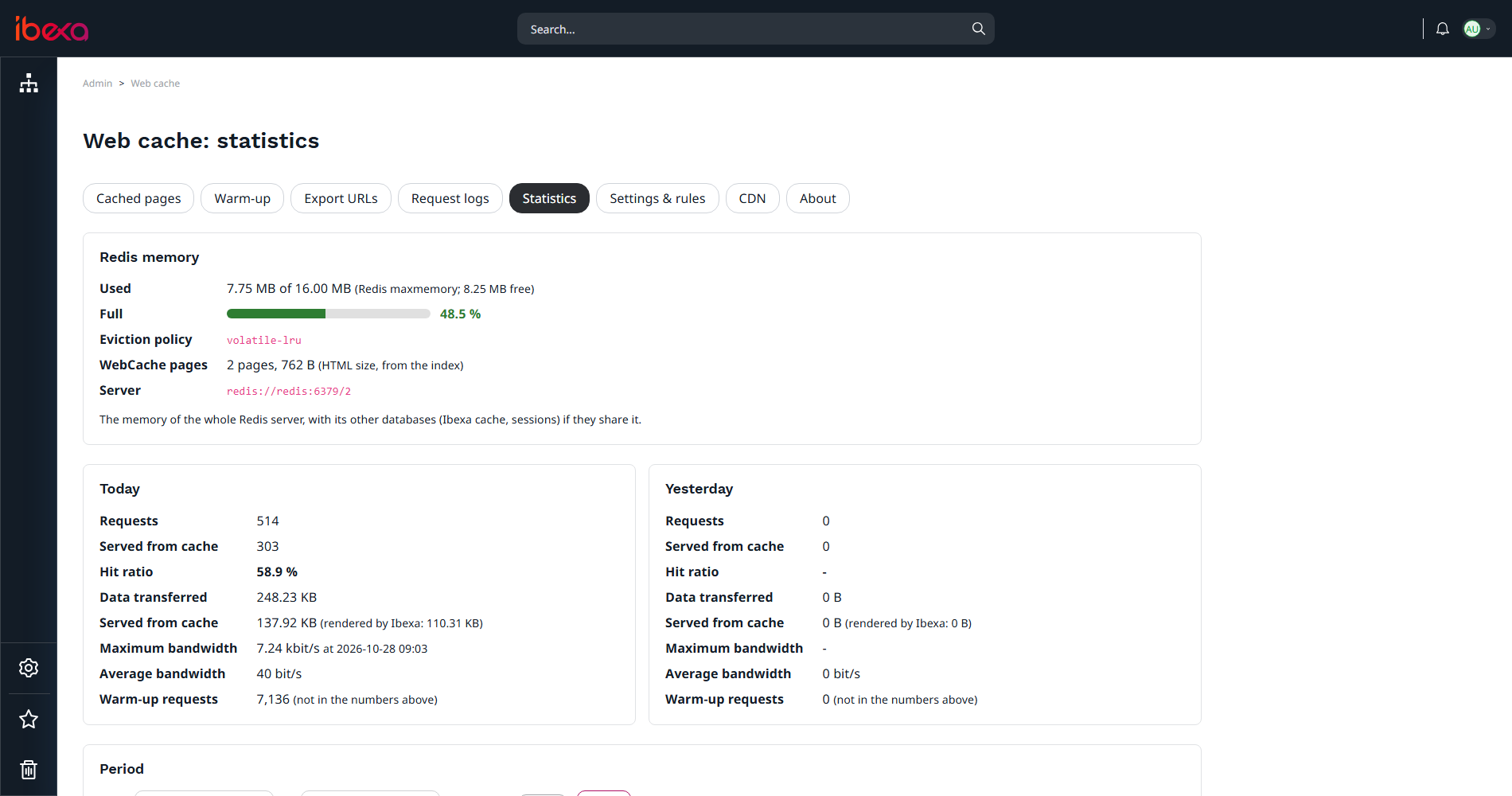
You can see the requests served from cache and the hit ratio, and the amount of Data transferred.
Also the bandwidth usage per minute from pages (not counting images).
Very useful to detect possible bottlenecks between the CDN and your servers.
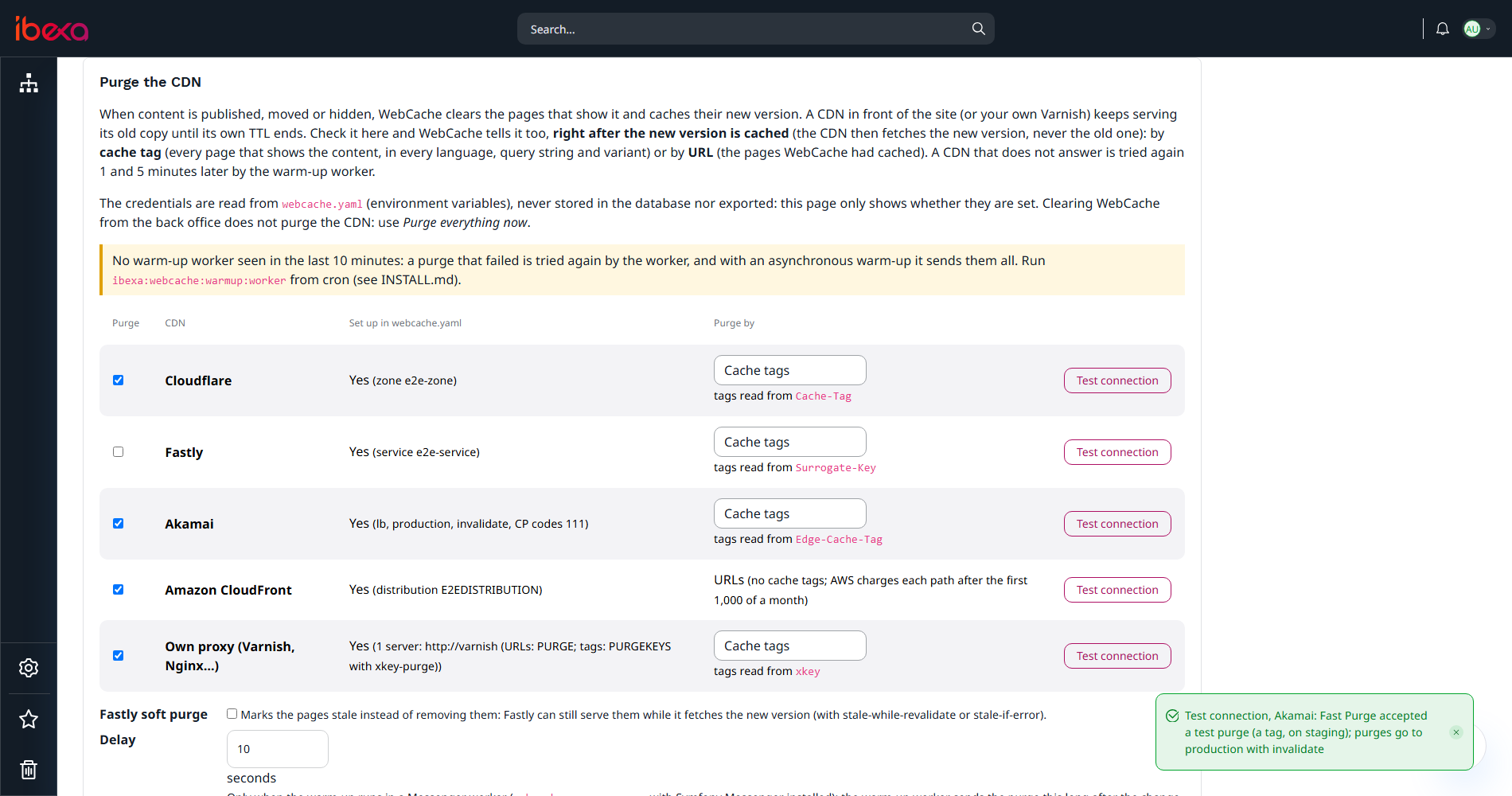
If you provide the credentials, Web Cache will talk to your CDN provider (like Fastly), and will tell what contents have been updated, and so they will be cleared from the CDN's cache, and re-fetched from origin.
Requirements
Ibexa 4.6.x: OSS, Headless, Experience or Commerce- PHP: 7.4 to 8.3
Ibexa 5.0.x: OSS, Headless, Experience or Commerce
- PHP: 8.3 to 8.5 (latest)
Cache storage: Redis 5+ (ext-redis or Predis) or a writable folder (shared between servers in a cluster)
Quality
Every release is tested on real Ibexa DXP 4.6 and 5.0 independent clusters (each environment with: two servers behind a load balancer, shared database and Redis. ESI support also adds a Varnish server), with both Redis and disk storage, three sites on two domains and two languages, plus automated unit tests.Every release passes unit testing, functional tests, end-to-end checks as well as human manual tests.
What you get
- The WebCache for Ibexa package (a Composer-ready zip for Ibexa 4.6 or Ibexa 5.0).
- Easy command line installer that configures everything.
- Step-by-step installation guide for manual install.
- Ready-to-use configuration file with every option explained.
- Changelog.
- License valid for Ibexa 4.6.x and for Ibexa 5.0.x (for when you update)
- A license for Staging/Preproduction
Installation in about 1 minute
Use the installer, that verifies everything, ask the questions and setup the system, or if you prefer to do it manually:
- Add the package with Composer.
- Enable the bundle and copy the two configuration files.
- Set Redis or a disk path.
- Run one command to create the tables.
- Done: open Admin > Web cache in the back office.
FAQ
Do I still need Varnish or a CDN?No. WebCache works on its own. If you already use Varnish, Fastly or Cloudflare, keep them: WebCache sits behind them as a fast origin cache and keeps their purge tags working.
What do logged-in users see?
Always the live site. Pages are never cached for, or served to, logged-in users.
How quickly do editors' changes appear?
Immediately after publishing. The affected pages are cleared and the content's pages are rebuilt at once.
Does it work with several servers?
Yes. All servers share the same cache through Redis or a shared disk. Settings and clears apply to every server at once.
Can I exclude a page?
Yes. Click "Never cache this page" in the cache manager, set it on the content item, or exclude URL patterns and content types in the configuration.
What about search pages?
With the supplied configuration, search results are never served from the cache, so visitors always get current results. Paginated listings can be cached page by page and are refreshed on publish.
What happens on a traffic spike when a page expires?
Only one request rebuilds the page. The others get the previous copy for a few seconds, or wait briefly for the new one. Your servers don't get hit with the same work hundreds of times.
What happens with pages with CSRF?
Pages with CSRF are never cached.
Ibexa and Ibexa DXP are trademarks of Ibexa AS. WebCache for Ibexa is an independent product and is not affiliated with or endorsed by Ibexa AS.
€5,000
/년
라이선스 정보
- 라이선스 유형 상용
- 향후 버전/업데이트 다운로드 1년
- 라이선스 결제 주기 매년
변경 내역
이 변경 내역은 영어로만 제공됩니다. 영어 페이지 보기
Changelog
1.16.2 (2026-11-01)
Fixed: Ibexa users with cookies (editors, logged-in users) did not get the cached error pages of "Keep one copy per error" (Error cache). A missing URL was rendered for them every time, while visitors got the cached copy.
Unless "Ibexa users (with Cookies) see live contents" is on, they now get the shared copy too (X-WebCache: HIT shared-error cookie-user). As with pages, their visits never create or refresh it.
One copy per URL already worked for them.
Upgrading: nothing to run.
1.16.1
Server-Timing for the page's own JavaScript: with debug_header on (the default), WebCache sends Server-Timing: webcache;desc="HIT" (or MISS, BYPASS…) next to X-WebCache. For a page from the cache it adds webcache-cached;desc="<when it was generated, UTC>". JavaScript can read it (performance.getEntriesByType('navigation')[0].serverTiming), unlike X-WebCache, so a page can tell its visitor whether it came from the cache. An app's own Server-Timing metrics are kept; the header is never stored with a page.
The Travel demo has its own error pages: 404 ("Off the map"), 500 ("Turbulence ahead") and a generic one for the others, in English, French, Spanish and Catalan.
A "ticket" on each page says whether it was served from the cache, with the date and time the copy was generated, or rendered live.
The missing path is shown by the browser, since one cached copy serves every missing URL.
/travel-demo/server-error shows the 500 page.
Other site accesses keep Symfony's page.
Upgrading: nothing to run.
1.16.0
Never cached in the back office: in Admin > Web cache > Settings & rules, the Never cached card now edits the excluded paths (one regex per line) and the excluded content types, which were only shown from exclude_paths and exclude_content_types of webcache.yaml.
Saving keeps a copy in the database that replaces both YAML lists on every server; Back to YAML removes it. The settings saved before 1.16.0 keep the YAML lists.
The copy applies wherever the lists did:
the pages never cached;
the content types never cached;
"Do not log Excluded paths";
the defaults of the warm-up and Export URLs forms and commands;
ibexa:webcache:content-type-fields.
Invalid entries are refused with the reason, and the form keeps what was typed.
Exported and imported with the settings. ibexa:webcache:configure --show prints exclusions yaml or backoffice (N paths, M content types); ibexa:webcache:status prints "Never cached".
Upgrading: nothing to run. Pages cached before you add a path or content type stay until they expire or are cleared.
1.15.1
Two fixes found by the code review of 1.14.7 (its last reviewer reported after 1.15.0):
A CDN purge is no longer lost when the process is killed during the publish warm-up. Without an asynchronous warm-up, the purge was kept in memory until the warm-up in the request had finished; a PHP-FPM request_terminate_timeout or an out-of-memory error during a long warm-up lost it, with nothing in Last purges and no retry. It is now queued before the warm-up and sent right after it, as before; if the process dies in between, the warm-up worker sends it 2 minutes later.
A warm-up worker waiting for jobs (--wait) sees the settings changed in the back office. It kept the settings it had read until a job came: a change to Fastly soft purge, or to the query parameter rules (1.15.0), only applied to the purges it sent after its next job or a restart. It now reads them again after each wait (5 s).
Upgrading: nothing to run.
1.15.0
Query parameters in the back office: Admin > Web cache > Settings & rules has a new Query parameters card. It shows the rules of webcache.query_params (for example the paginated News of the Travel demo, travel_news) and edits them: the default mode, and for each rule its name, path, mode (ignore, vary, bypass), params, page parameter, max pages, TTL and the content types or subtrees whose publication purges its pages. Rules can be added, removed and reordered (the first match applies).
Saving keeps a copy in the database that replaces the YAML rules on every server; Back to YAML removes it. The settings saved before 1.15.0 keep the YAML rules.
Invalid rules are refused with the reason (a regex that does not compile, a duplicate or invalid name, an unknown mode, a negative max pages or TTL, a subtree that is not a Location path string), and the form keeps what was typed.
The copy is exported and imported with the settings (Export / Import, ibexa:webcache:config:export|import), checked like the rest.
ibexa:webcache:configure --show prints query-params yaml or backoffice (N rules); ibexa:webcache:status lists them.
Upgrading: nothing to run (no new table). Clear the Symfony cache as usual.
The Warm-up help for "Also warm paginated pages" links to the new card.
The Travel demo's PHP sets session.upload_progress.enabled = 0 and session.use_strict_mode = 1 (mitigation of PHP2Shell).
1.14.8
Fixes to Purge the CDN (1.14.7), found by a code review:
An unset environment variable no longer breaks the site. The examples now use %env(default::VAR)%: a variable that is not set makes that CDN show as "not set up" in the CDN tab. With %env(VAR)%, one variable missing made every page and command fail, even with Purge the CDN off.
Large changes are no longer lost. Above 2,000 URLs a CDN purged by URL got a "purge everything" instead, which failed for Akamai without CP codes, Fastly with a purge_select token and Nginx. Now each CDN gets its URLs (up to 10,000; beyond, everything only for the CDNs that can do it: Cloudflare, CloudFront, Akamai with CP codes, your proxy by tags). CloudFront, which bills each path, is purged with /* above 300 paths.
The pages WebCache clears through its own rules reach the CDN too: list pages of query-parameter rules, invalidation_rules and cached error pages, by URL, to every CDN (their tags are WebCache's own, no CDN knows them).
The CDN is told even when WebCache's own purge fails (Redis down, a database deadlock).
Cache tags are sent as Ibexa purges them, with its repository prefix. tag_prefix is ignored: it added the prefix a second time on multi-repository sites. ibexa:webcache:cdn:purge --tag=c52 adds the prefix itself.
Own proxy: a URL a server has not cached (Nginx ngx_cache_purge answers 404 or 412) is no longer a failure, and every server gets every purge even after a failure. "Purge everything" (the tag ez-all) needs the proxy purged by tags and says how many objects Varnish purged; copies stored before the tags were added are cleared once with varnishadm "ban req.url ~ .".
Retries resend only what failed: a queued purge is about one API call (several rows for a large change, "part 1 of 3"), so CloudFront no longer bills the same paths again and a long purge is never sent twice at once.
Asynchronous warm-up only with Messenger: with webcache.warmup.async but no Messenger, the warm-up runs in the request, and so does the CDN purge (it waited for a worker that may not run). In a Messenger worker, purges are sent after each message instead of being dropped by the services reset.
Publishing with a CDN purged by URL is fast again: the URLs of the purged pages are read in one query, not one per page.
CDN tab: pressing Enter in Delay saves (it ran a Test connection); the tab renders when Redis can't be reached.
Cloudflare Test connection works with account-owned API tokens (webcache.cdn_purge.cloudflare.account_id) and shows the zone name when the token can read it.
Console: ibexa:webcache:cdn:purge --provider=… --url=… purges the URL also on a CDN purged by tags; configure --cdn-purge-delay is checked (0 to 3600).
A CDN's error page that is not UTF-8 can no longer leave a purge stuck in "sending"; the warm-up worker no longer queries the purge queue when no CDN is set up.
1.14.7
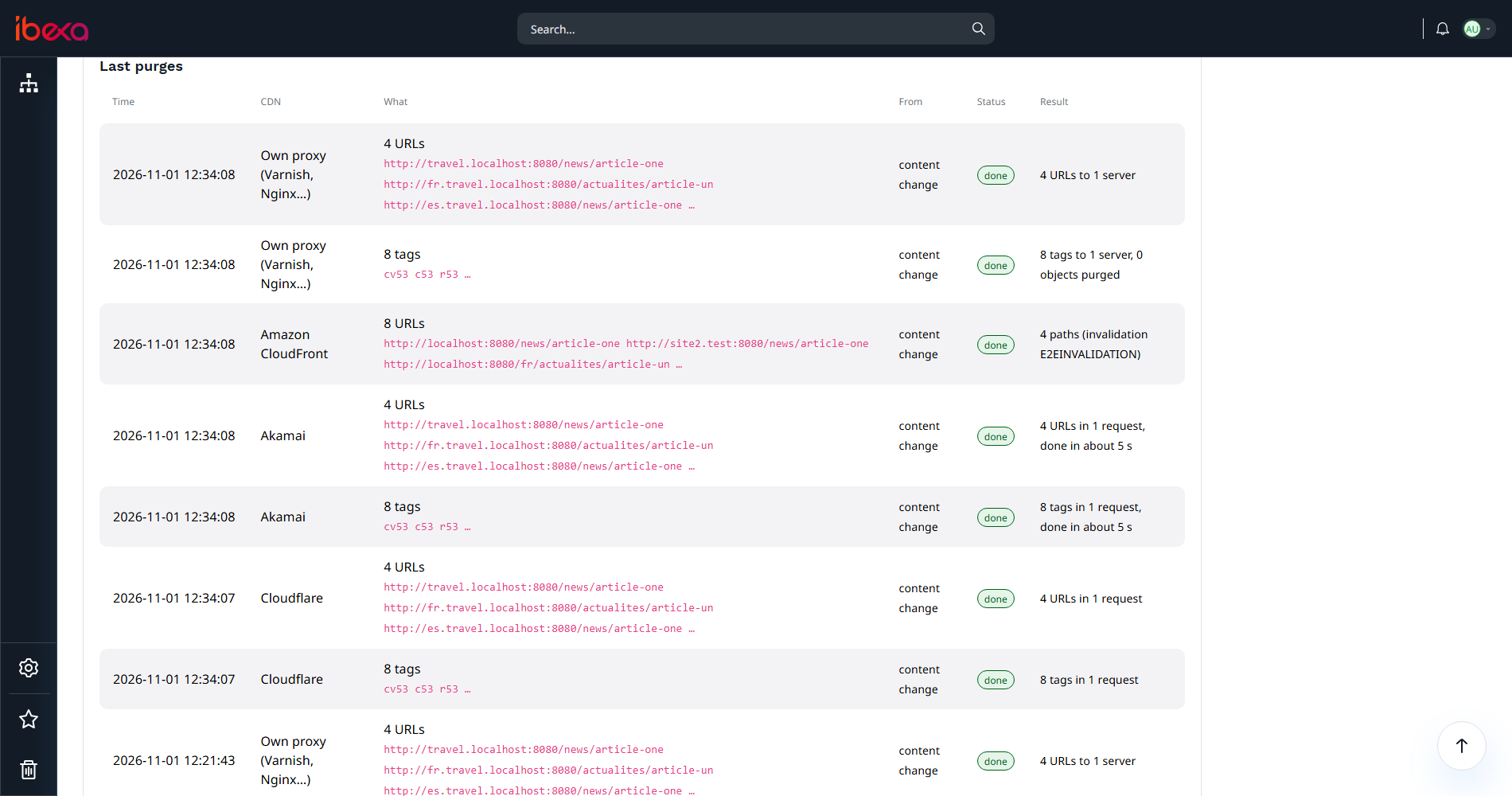
New in the CDN tab: Purge the CDN. When content is published, moved or hidden, WebCache clears the pages that show it and caches their new version; a CDN in front of the site kept serving its old copy until its own TTL ended. Now WebCache tells the CDN too, right after the new version is cached, so the CDN fetches the new version, never the old one.
Cloudflare, Fastly, Akamai (Fast Purge, EdgeGrid), Amazon CloudFront (invalidations, AWS Signature Version 4) and your own proxy (Varnish, Nginx…: PURGE per URL, PURGEKEYS with xkey-purge per tag, as Ibexa's and FOSHttpCache's VCL expect). Several at once.
Purge by cache tag (every page that shows the content, in every language, query string and variant) or by URL (the pages WebCache had cached; CloudFront purges by path only). By tag, WebCache adds the tags of each page in the header that CDN reads them from (Cache-Tag, Surrogate-Key, Edge-Cache-Tag, xkey), whatever Ibexa's purge_type, on rendered and cached pages.
Credentials only in webcache.yaml, from environment variables (webcache.cdn_purge): never in the database nor in the configuration export. The tab shows whether each CDN is set up (zone, service, distribution…, never a secret) and has Test connection (a harmless call), Purge everything now and Last purges (the 50 latest: what, when, result).
A CDN that fails is tried again 1 and 5 minutes later by the warm-up worker. With an asynchronous warm-up (webcache.warmup.async), the worker sends the purge after Delay (10 s by default). Fastly soft purge as an option.
Clearing WebCache from the back office does not purge the CDN: use Purge everything now.
Console: ibexa:webcache:cdn:purge --url=… --tag=… --all [--provider=…] (also --due and --list), ibexa:webcache:cdn:test, ibexa:webcache:configure --cdn-purge=cloudflare:tags,cloudfront:urls --cdn-purge-delay=10 --cdn-purge-soft=1; ibexa:webcache:status shows a "CDN purge" line. ibexa:webcache:gc keeps the last purges of 30 days.
Upgrading: run ibexa:webcache:install (new table webcache_cdn_purge). Off until a CDN is checked in the tab.
The Travel demo shows the installed version in its footer: "Demo of WebCache for Ibexa 1.14.7".
1.14.6
New tab Error cache (after Settings & rules): HTTP errors are cached like pages, each with its own TTL. Bots and scanners request random or well-known URLs all day (/wp-login.php, /.env…), and Ibexa renders a full error page for each of them; a cached error page is served from the cache in a few milliseconds.
Choose the codes: 400, 403, 404, 405, 410, 500, 502, 503 and 504. Checked by default: 404 (TTL 1 hour), 500 and 502 (1 minute).
Keep one copy per error (on by default): every URL with the same error shares one cached page per site access. A URL that ends in that error (a 404 from the router, a 500…) is answered with it at once, before the error page is rendered, even on the first visit of a new random URL (X-WebCache: HIT shared-error). Uncheck it when the error page shows something specific to each URL: each URL then gets its own cached error page. Changing it removes the error pages cached in the other mode.
Choose the TTL of each code from the same list as the page TTLs, from 1 minute to 1 year, or Never expires. With Never expires or a very long TTL on a 4xx, the tab warns that every URL a bot tries stays cached (with Redis volatile-lru, entries without expiry are never evicted).
Every other rule still applies: anonymous GET only, excluded paths, "Never cache" rules, no page that sets a cookie or starts a session (a page with a CSRF token is never cached).
A 5xx never replaces a good page: when the regeneration of a cached page fails, the last good version is kept.
With one copy per URL, publishing a content removes the cached errors of its URLs, so a new page shows at once (with one copy per error, a new page routes normally).
The tab lists the error pages cached now (count per code, the 20 most recent) and has Clear cached error pages; console: ibexa:webcache:clear --errors. Cached pages and the page details show an "HTTP 404" badge.
Console: ibexa:webcache:configure --error-pages=404:3600,500:60,502:60 (404:0 = never expires, empty = none) and --error-pages-shared=1|0; ibexa:webcache:status shows an "Error cache" line; the configuration export/import carries error_pages and error_pages_shared.
Upgrading: run ibexa:webcache:install (adds the http_status column to webcache_entry). Until then error pages are not stored. After the upgrade, 404, 500 and 502 are cached with the default TTLs: uncheck them in the tab to keep the old behaviour.
Request logs shows the server time: "This page was loaded at server time: 2026-10-30 17:38", with the time zone of the logged times.
1.14.5
CDN > IP Addresses now shows the client IP logged for this request, and says when the chosen Client IP source is ignored, and why. For example, with X-Real-IP and an empty Trusted proxy IP ranges: "X-Real-IP is ignored: REMOTE_ADDR 10.0.0.5 is not in the Trusted proxy IP ranges (empty: never trusted), so REMOTE_ADDR is used", with a link to that field. Until now the Detected now list showed the headers before this trust check, so the page could show the visitor's IP while the request logs stored the proxy's address. The rule itself is unchanged: a forwarded header is used only when the connection comes from the ranges trusted for it.
CDN > Continent warns when "Work with Continent Cache Variants" is on but the Client IP source is not a CDN (Cloudflare, Fastly, Akamai or Amazon CloudFront): only these send the continent, so every visitor gets the version without continent.
1.14.4
Fixed: the site warm-up and Export URLs of a site access whose content tree root is not the Home Location (content.tree_root.location_id, e.g. one site of a multi-site installation rooted on its own folder) built URLs with the path of that root as a prefix (/my-site-home/news instead of /news). Every warmed page failed with a 404. Ibexa gives the URL generator the tree root of the site access only in a web request, not in the console command (--siteaccess) where the URLs are collected; WebCache now gives it. Sites rooted on Home were not affected.
1.14.3
New tab Test (after About): an artificial delay of 1, 5, 10, 15 or 30 seconds on every page not served from the cache, to see which pages are not cached and feel the speed difference.
Delayed: every page of the cached site accesses that Ibexa renders, MISS (then stored as usual) or BYPASS (never cached: logged-in users, forms, excluded paths…). Never delayed: pages served from the cache (HIT), the back office and the warm-up.
Delayed responses carry X-WebCache-Test-Delay: <seconds>.
It switches itself off after one hour, on every server: it is kept in the shared storage with an expiry, not in the database, and never exported with the configuration.
While it is on, every WebCache tab shows a warning banner, and ibexa:webcache:status shows a "Test delay" line.
Console: ibexa:webcache:test-delay [1|5|10|15|30|off] [--minutes=60].
Fixed: after a publish, a site access matched by host (e.g. site2.test) whose page was not cached yet was warmed under a wrong URL, http://www.example.com/site2/news/… (Ibexa builds a site access URL with its first matcher, often URIElement), instead of http://site2.test/news/…. Visitors never requested that URL, and the real page stayed uncached until its first visit. The warm-up now uses the public base URL of the site access (webcache.warmup.sites), as the site warm-up does.
ibexa:webcache:gc removes the pages older versions cached under such a URL (only on another host, never a /fr/… page of a site access whose base URL ends with /fr).
ibexa:webcache:status warns about a cached site access without a public base URL.
1.14.2
Rules for a whole subtree. The Web cache tab of a Location has a new checkbox, "Also for every page below this Location". A TTL or "Never cache" set on, for example, a site's home or a section then applies to all its pages. Until now a Location rule applied only to the page of that Location.
The closest rule up the tree wins. A page's own rule, its own Cache TTL / Never cache fields, and a URL rule all win over an inherited rule.
Saving or removing such a rule clears the cached pages of the whole subtree. The details of a cached page say "from the rule of a parent Location, for every page below it".
Settings & rules > Page rules shows "Location 364 and every page below it". The export/import of the configuration carries the new subtree flag (files of older versions import as before).
Upgrading: run ibexa:webcache:install (adds the subtree column to webcache_rule). Until then the rules work as in 1.14.1.
1.14.1
Statistics shows how full the storage is, on top of the tab:
Redis: the memory used by Redis against its maxmemory, the percentage full (green, orange from 80 %, red from 95 %), the free memory and the eviction policy. Without maxmemory (the Redis default), against the RAM of its server, with a warning: Redis can take all of it. With maxmemory-policy noeviction, a warning that a full Redis refuses new pages. Read with INFO memory only, so it works on managed Redis (ElastiCache, Azure Cache…).
Shared disk (filesystem storage): the space used on the disk (or mount) holding the path, against its size, and the percentage full.
WebCache's own pages and their HTML size, from the index (no scan of Redis or the disk).
Console: ibexa:webcache:stats and ibexa:webcache:status print the same line, e.g. 1.27 GB of 4.00 GB (31.8 % full, Redis maxmemory).
It is read live and does not depend on webcache.statistics.enabled.
1.14.0
New tab Statistics (after Request logs):
Today and Yesterday: requests, requests served from the cache, hit ratio, data transferred (in the highest unit, e.g. 10.53 GB), data served from the cache, maximum bandwidth (the busiest minute, in Mbit/s, with its time), average bandwidth, warm-up requests (counted apart).
Period (from/to, site access): the same numbers, and the graph of the bandwidth over the period (all requests and served from cache), plus the requests; one point per minute up to a day, per hour up to a month, per day beyond.
Console: ibexa:webcache:stats [--from=YYYY-MM-DD] [--to=…] [--sa=…]; ibexa:webcache:status shows today's numbers.
How it counts: every request of the cached site accesses that reaches the web servers, once the response is sent: one Redis call (or a counter file per server in filesystem mode), no database write per request. The warm-up worker cron (every minute), ibexa:webcache:gc and the tab move the closed minutes to the database (webcache_stats). Minute detail is kept 30 days, then one row per day (webcache_stats_daily, with the busiest minute), kept forever.
Configuration: webcache.statistics.enabled (default true; false: nothing is counted, no Redis write) and webcache.statistics.retention_days (default 30).
Upgrading: run ibexa:webcache:install (creates the two tables).
1.13.0
ESI support for pages with render_esi() behind Varnish or Fastly with ESI. A page has two cached versions:
the ESI version, for requests that can assemble ESI (Surrogate-Capability with ESI/1.0, as Ibexa's Varnish VCL sends): it holds the <esi:include> tags and keeps Surrogate-Control: content="ESI/1.0", so Varnish/Fastly assemble it on every hit, and the fragments stay cached by Varnish/Fastly with their own TTLs;
the plain version, for everybody else (direct requests, the warm-up through internal_base_url): the fragments are rendered inline.
Before 1.13.0 both shared one cache entry, so a copy with <esi:include> tags could be served to a client that cannot assemble them, and a copy with inline fragments to Varnish.
Only when Symfony ESI is on (framework.esi); otherwise nothing changes. The cache keys of the plain version are unchanged: upgrading keeps the cached pages.
X-WebCache shows … esi for the ESI version; Cached pages and the page details show "ESI version (Varnish/Fastly)".
Warm-up: new option Also warm the ESI version (console --esi, also with --url). The ESI version is signed like the Proxy Variants (a visitor cannot ask for it), and the warm-up tells Symfony which version to render whatever proxy the request goes through. Checked by default when ESI versions are cached.
Publishing and purging regenerate the ESI version of a page too, when it was cached.
Fixed: "Never cache this page" deleted only the version shown; the other versions of the URL (Proxy Variants, ESI) kept being served. It now deletes every version.
Upgrading: run ibexa:webcache:install (adds webcache_entry.esi). Until then plain pages are cached as before.
Tests: the e2e stacks have a Varnish 7.6 with Ibexa's own varnish7.vcl in front of the load balancer, and an ESI fragment on the folder pages.
1.12.1
Export / Import configuration (new card at the bottom of Settings & rules), to copy the configuration from Production to Staging:
Export downloads webcache-config-<host>-<YYYY-MM-DD-HHMM>.json: the WebCache version, the settings of Settings & rules and CDN (General, Other methods, Proxy Variants, Log requests, Client IP source and IP ranges) and all the page rules (per URL and per Location). The licence and the order key are never exported.
Import: the file is validated first, and every error is listed (not JSON, not a WebCache file, a newer WebCache version, wrong values, invalid IP ranges or path prefixes, continent variants without a CDN, invalid rules, a licence or order key in the file). A valid file shows a preview: every setting now and after the import, the changes highlighted, the rules of the file, warnings (older version, the other package, site accesses or Locations not found here) and a warning that the import replaces the current settings and all the page rules on every server. Nothing changes until Confirm import. Optionally, all the cached pages are cleared.
Files from this version or older are accepted. Settings a file does not have take their default values.
Console: ibexa:webcache:config:export [--file=…] and ibexa:webcache:config:import <file> [--dry-run] [--clear-cache], with the same checks.
Needs the Web cache / configure permission. No database change.
1.12.0
Serve other methods as GET (Settings & rules > General > Other methods, off by default). Bots send POST, PUT, DELETE, PROPFIND… to pages that only make sense with GET (e.g. POST /), and the CDN lets them reach the servers: each one rendered a full page. With the option on, such a request to a page that WebCache caches is treated as a GET before routing: its body is ignored and it is served from the cache, or the page is rendered once as a GET and stored (X-WebCache: HIT as-get / MISS as-get).
Never changed: GET, HEAD and OPTIONS (CORS checks), /admin and the excluded paths, searches (bypass rules), logged-in users (session cookie), requests with Authorization.
Paths that keep their method: prefixes of pages with forms posted to their own URL, one per line (/contact covers /contact, /contact/… and /fr/contact, not /contacts).
The request logs keep the method sent (e.g. PROPFIND, served from cache).
Console: ibexa:webcache:configure --methods-as-get=0|1 --keep-method-paths=/contact,/form; ibexa:webcache:status shows the option.
Installer: one more question, "Serve POST, PUT, PROPFIND… to cacheable pages from the cache, as GET?" [no], and the prefixes that keep their method.
No database change. Scripts that post the General settings without the new fields keep the option as it is.
1.11.0 (2026-10-16)
Installer webcache-installer-1.11.0-linux-amd64: one static binary for Linux amd64 (Ubuntu 24.04, Ubuntu 26.04, Debian 13) that installs and configures WebCache in a few minutes, for Ibexa DXP 4.6 and 5 (it carries both packages and installs the one matching the site). It checks the requirements, finds the Ibexa folder and version, registers the installation with the order key (from order_key.txt next to the installer, or asked), asks the configuration (content type fields, CDN, request logs, crons, Redis or folder storage, TTL, cookie users, Proxy Variants), backs up every file it changes as <file>-bck-<YYYY-MM-DD>-<HHMM>, then installs, records the licence and writes /etc/cron.d/webcache-for-ibexa. See INSTALL, "0. The installer".
New console commands, used by the installer and handy for automation:
ibexa:webcache:license (--show; --set=<licence> with --servers, --registered-at, --order-key): shows or stores the licence (About shows it as usual);
ibexa:webcache:configure: sets the runtime settings of Settings & rules and CDN (enabled, default TTL, cookie users, Proxy Variants mode and CIDR, request logs, Client IP source, custom header, trusted proxies, the CDN ranges), with the same checks as the back office; options not given are kept; --show prints them;
ibexa:webcache:content-type-fields (--list; --add=article,folder or --add=all): adds the optional webcache_ttl and webcache_disable fields to the content types you choose.
ibexa:webcache:install --no-register: creates the tables without registering (the installer registers with the order key and stores the licence itself).
No database change.
1.10.0
Warm-up: new option Also warm paginated pages (console --paginated). Besides each page, the warm-up also generates its pages 2 to max_pages for the paginated vary rules of query_params (the page parameter in params, max_pages set): /news → /news?page=2, /news?page=3… Before, paginated pages were only re-warmed after a visitor had requested them. The form lists the rules used, and the paginated rules skipped because they have no max_pages; the job page shows the option.
Docs: why a paginated page may never be cached while you browse logged in (visitors with a session cookie are served cached pages but never create them).
1.9.0
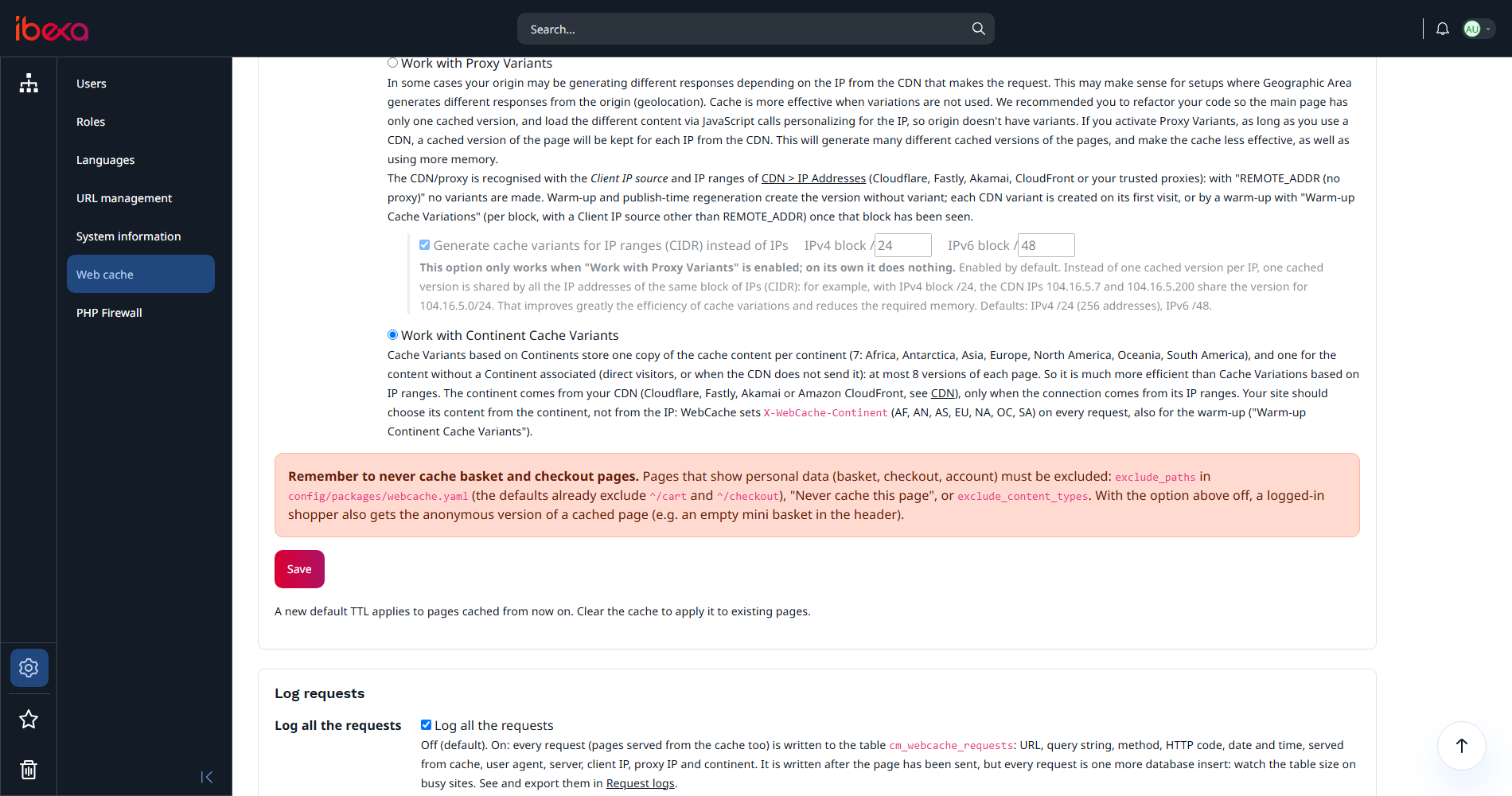
Work with Continent Cache Variants (Settings & rules > General > Proxy Variants): one cached version of each page per visitor continent (Africa, Antarctica, Asia, Europe, North America, Oceania, South America) plus one for the content without a continent, at most 8 versions of a page, much more efficient than the variants per IP range. The continent comes from the CDN (Cloudflare, Fastly, Akamai or Amazon CloudFront as Client IP source in CDN > IP Addresses), only from its IP ranges; the option is available only behind one of them. Proxy Variants is now a choice: off, per CDN IP ("Work with Proxy Variants") or per continent.
WebCache sets X-WebCache-Continent (AF, AN, AS, EU, NA, OC, SA) on every request it gets the continent for, and removes one sent by a visitor, so the site can choose its content from one header whatever the CDN.
Warm-up: new option Warm-up Continent Cache Variants, available when "Work with Continent Cache Variants" is on: each URL is warmed for the version without continent and for the 7 continents, each request reaching the site with X-WebCache-Continent (and the CDN's own continent header) set to that continent.
Cached pages and the page details show "Continent variant: Europe (EU)"; ibexa:webcache:status shows the mode. No database change.
1.8.0
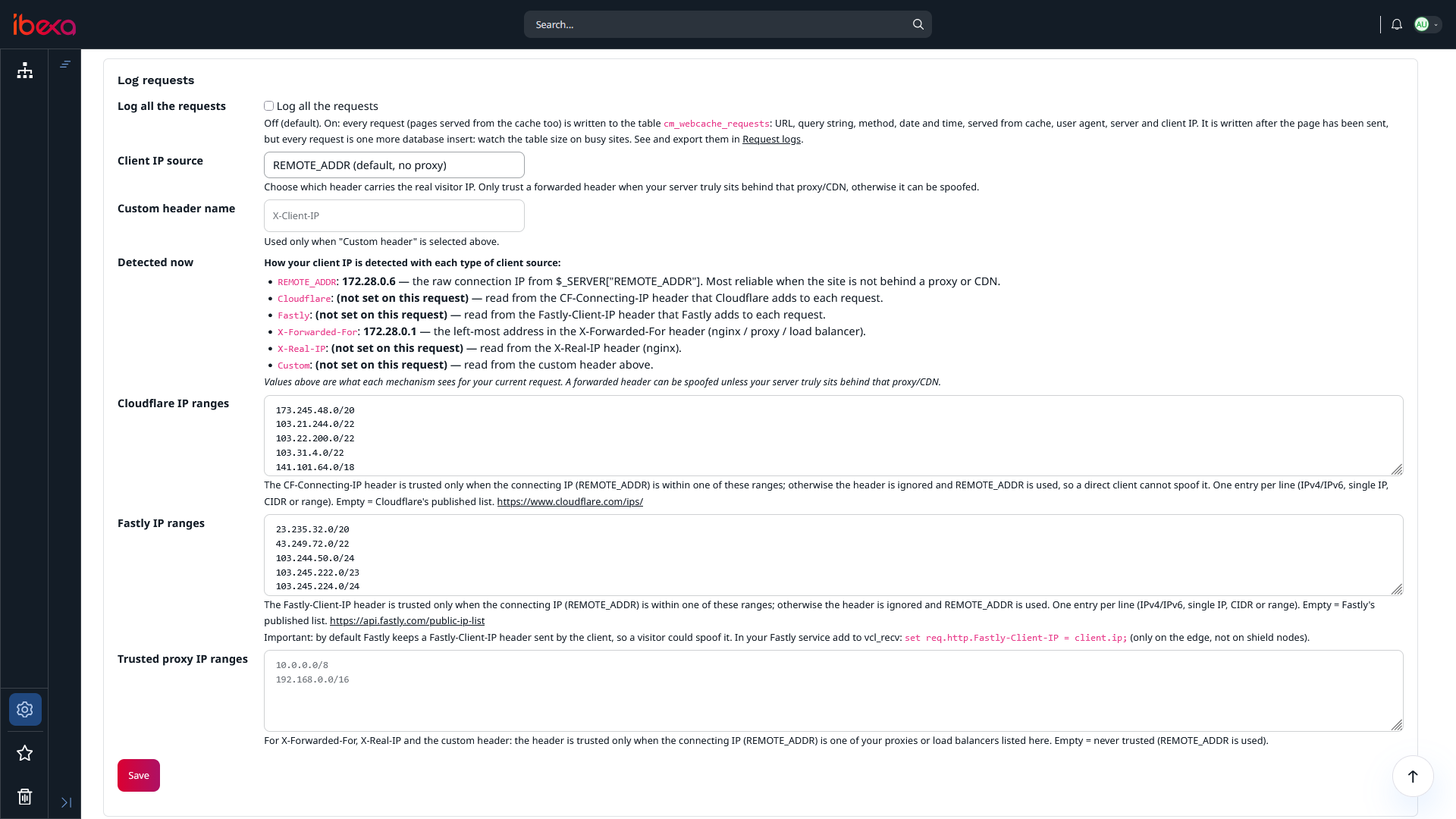
New CDN tab, after Settings & rules, with the card IP Addresses: the Client IP source, the custom header, what each source sees on your request, and the Cloudflare, Fastly, Akamai, CloudFront and trusted proxy IP ranges. They were in the Log requests card of Settings & rules, which keeps the logging options and shows where the client IP is read from.
Akamai (True-Client-IP) and Amazon CloudFront (CloudFront-Viewer-Address, else the left-most X-Forwarded-For) as Client IP sources, as in the PHP Firewall. Their IP ranges come pre-filled (Akamai Origin IP ACL; the CLOUDFRONT ranges of AWS) and can be edited; the header is trusted only from those ranges. Proxy Variants and Warm-up Cache Variations work with them too.
Request logs: new column Continent (continent, AF, AN, AS, EU, NA, OC, SA) behind Cloudflare, Fastly, Akamai or CloudFront, from the continent or country the CDN sends: cf-ipcontinent or CF-IPCountry; Fastly-Geo-Continent or Fastly-Geo-Country (set in VCL); X-Akamai-Edgescape; CloudFront-Viewer-Country. Shown in Request logs, selectable in the CSV export, and a new export filter with the 7 continents plus "Undetected / empty", all checked by default.
Upgrading from 1.7.x: install the new version, run ibexa:webcache:install (adds cm_webcache_requests.continent), clear the Symfony cache. Until then requests are logged as before. The IP settings are kept. Scripts that post them to settings/request-log keep working; the Log requests form keeps them when they are not posted.
1.7.0
Warm-up: new option Warm-up Cache Variations. Besides the version without variant, each URL is also warmed for every Proxy Variants block (CIDR) that already has cached pages, so CDN nodes get a HIT on their first visit. Available only when Settings & rules has "Work with Proxy Variants" and "Generate cache variants for IP ranges (CIDR) instead of IPs" enabled and a Client IP source other than REMOTE_ADDR; the form shows the configured Client IP source next to the option, the number of blocks per site access, and what is missing when it is not available. At most 100 blocks per site access; the cost is URLs × (1 + blocks).
Warm-up requests now declare the version they build in a signed header (X-WebCache-Warmup-Variant): the version without variant unless a block is asked for, whatever route they take. Before, a warm-up sent through a trusted proxy built that proxy's variant.
"Already cached" (re-running a job without "Regenerate all") is checked for every version of a URL.
The job page shows the option. No database change.
1.6.2
Fixed: in Warm-up and Export URLs, "Choose site accesses" showed each site's public base URL followed by the site access name and a parenthesis (e.g. http://localhost:8080site)). It now shows the base URL alone; the "(no public base URL: set webcache.warmup.sites.)" hint still appears for site accesses without one.
Fixed: in Warm-up, the text "Every visible Location under the site access root…" sat on the URLs row and looked like the description of "All sites", shown even with "Choose site accesses". "All sites" now has its own description under the radio buttons ("Every cached site access: …", with a hint when one has no public base URL), hidden when "Choose site accesses" is selected, and the URLs row reads "Collected from the content tree: every visible Location under the root of each selected site access, in its languages."
1.6.1
Proxy Variants: new sub-option Generate cache variants for IP ranges (CIDR) instead of IPs, enabled by default. One cached version is shared by all the CDN/proxy IPs of the same block (IPv4 /24 and IPv6 /48 by default, editable), e.g. 104.16.5.7 and 104.16.5.200 share 104.16.5.0/24, instead of one version per IP: far fewer versions and much less memory. It only works when Work with Proxy Variants is enabled.
The cached-pages list and the page details show the block ("Proxy variant: 104.16.5.0/24"); ibexa:webcache:status shows the mode. The request log still stores the exact proxy IP.
Upgrading from 1.6.0 with Proxy Variants on: variants become per block. The per-IP versions are no longer used and expire with their TTL (or run ibexa:webcache:clear --all). No database change.
1.6.0
Work with Proxy Variants (Settings & rules > General, off by default): one cached version of each page per CDN/proxy IP, for origins that answer differently depending on the CDN node (geolocation). The CDN/proxy is recognised with the Client IP source and IP ranges of Log requests; direct visitors and untrusted connections share the version without variant. The cached-pages list and the page details show "Proxy variant"; ibexa:webcache:clear --url clears every variant; purges by tag (publish) reach them all.
Request logs: new optional column proxy_ip (IPv4/IPv6 of the trusted proxy that made the connection, empty for direct visitors), shown as Proxy IP and selectable in the CSV export.
Upgrading from 1.5.x: install the new version, run ibexa:webcache:install (adds webcache_entry.variant and cm_webcache_requests.proxy_ip), clear the Symfony cache. Until then, pages are cached and requests logged as before; turn Proxy Variants on only after the upgrade.
1.5.2
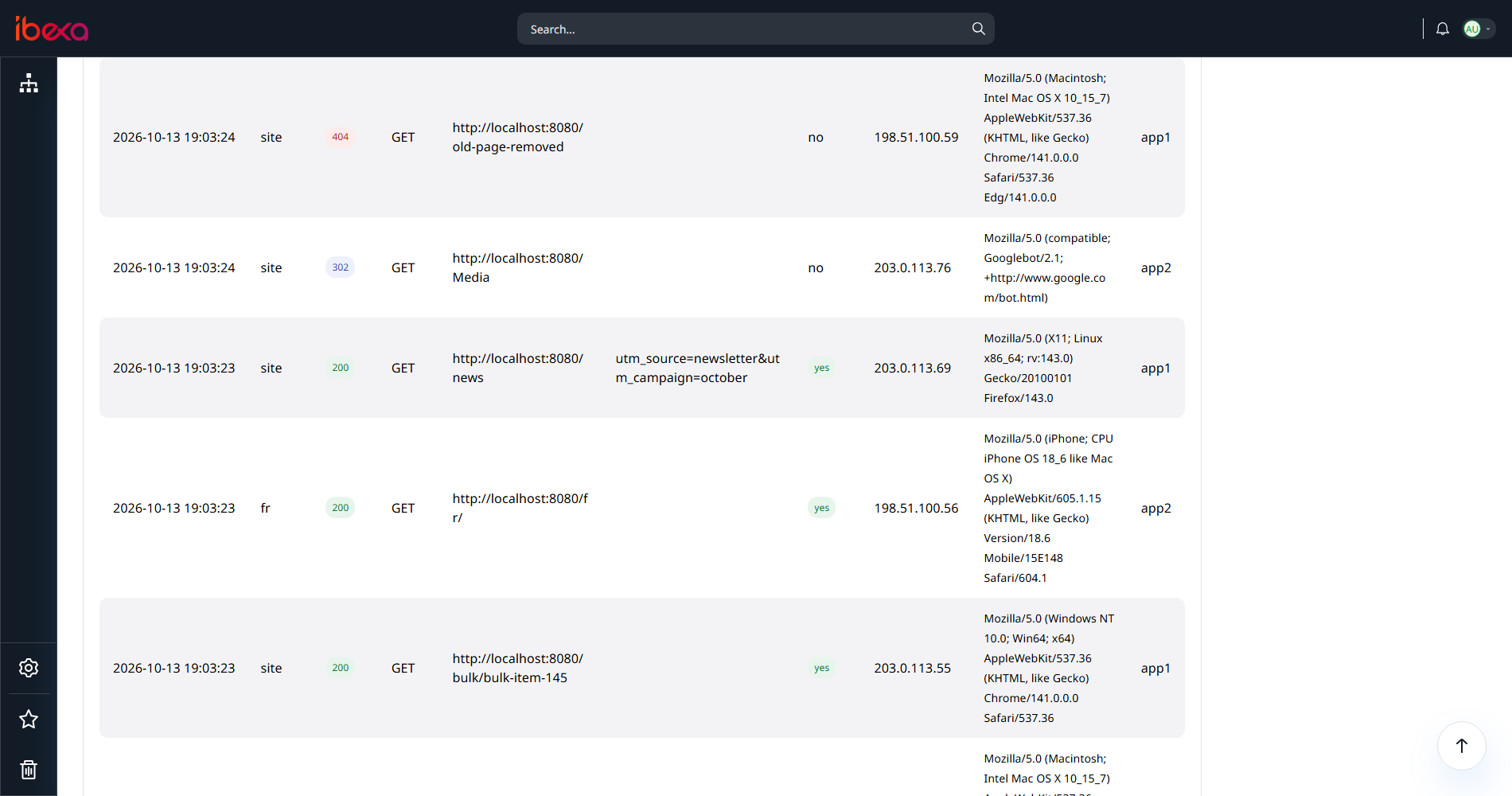
Request logs: new column http_code (INT) in cm_webcache_requests with the HTTP status of each request (200, 302, 404, 500, 502…), shown as HTTP Code before Method in Request logs and exported in the CSV.
Export as CSV: filter by HTTP code class, 2xx, 3xx, 4xx, 5xx (all checked by default = every request, also those logged before 1.5.2 without a code).
Upgrading from 1.5.x: install the new version, run ibexa:webcache:install (adds the column), clear the Symfony cache. Until the column exists, requests are still logged (without the code).
1.5.1
Settings & rules > Log requests: Do not log Excluded paths (the exclude_paths of the configuration: login, user, cart, checkout, API, _fragment…) and Do not log /admin/ requests (the back office), both on by default.
Request logs > Export as CSV: filter by date and time (from / to, both optional, server time).
Upgrading from 1.5.0: install the new version and clear the Symfony cache. Logging settings saved with 1.5.0 get both new options on.
1.5.0
Log requests (Settings & rules): "Log all the requests", off by default. Every request is written to the new table cm_webcache_requests (url, query_string, protocol, datetime, served_from_cache, user agent, server_hostname, client_ip, siteaccess), after the response is sent.
Client IP detection as in the PHP Firewall: REMOTE_ADDR (default), Cloudflare, Fastly, X-Forwarded-For, X-Real-IP or a custom header. A forwarded header is only trusted from the Cloudflare ranges, the Fastly ranges (both pre-filled and editable) or the trusted proxy ranges. The card shows what each source sees for the current request.
New Request logs tab: the latest requests (25 per page), CSV export (choose the fields, and all or chosen site accesses), clear logs. Console: ibexa:webcache:requests:clear [--older-than=DAYS].
Upgrading from 1.4.x: install the new version, run ibexa:webcache:install (new table), clear the Symfony cache.
1.4.3
Registration of the installation with carlesmateo.com (API register-install, product webcache_ibexa), like the PHP Firewall products. It runs the first time WebCache is used: ibexa:webcache:install, a Web cache back office page (after the page is sent), or a warm-up worker. It sends the server facts of API 1.6, including up to 50 network interfaces (name, link speed, IP). The licence (wci-…) is stored in webcache_setting and shown in Settings & rules and ibexa:webcache:status. If it cannot register, nothing is shown; it tries again after 4 hours (one attempt for all servers). Visitors' pages never trigger it.
New About tab in Admin > Web cache: "WebCache Enterprise v. 1.4.3" (linked to the product page) and "License registered" with the registration date, or "Unlicensed".
Upgrading from 1.4.2: install the new version and clear the Symfony cache. No database change.
1.4.2
Export URLs (Admin > Web cache > Export URLs and ibexa:webcache:urls:export): a text file with the public URLs of all sites or chosen ones, one per line, with the warm-up filters (excluded Location IDs with their children, excluded paths, excluded content types, pre-filled from the configuration) and a maximum number of URLs (default 1,000,000, 0 = no limit). One sub-process per site access, streamed: constant memory, any size.
ibexa:webcache:warmup --url-file ignores lines starting with #.
Upgrading from 1.4.1: install the new version and clear the Symfony cache. No database change.
1.4.1
Warm-up form: Test connectivity button next to "Send requests to (internal_base_url)". The next warm-up worker (cron or supervisor) requests the home page of the site through that address, and the form shows the result: connected, connected but answered by a proxy/CDN cache or with another status, or the full error message. It runs on a worker because http://127.0.0.1 is the server where the workers run, not the web server.
Failed URLs keep their whole error message (up to 1,000 characters instead of 100), and the job page wraps it. Before, a message such as Failed to connect to 127.0.0.1 port 80 … for "http://127 was cut and looked like a truncated address.
Fix: a page answering 4xx or 5xx during a warm-up (e.g. a 404) made the worker stop the whole block with an error, and its URLs waited 10 minutes to be retried. The status is now the result of the URL (404, 503 after retries).
Upgrading from 1.4.0: install the new version, run ibexa:webcache:install (widens webcache_warmup_url.result), clear the Symfony cache. Until then, results are cut at 100 characters as before.
1.4.0
Settings shows the paths (exclude_paths) and content types (exclude_content_types) that are never cached.
Warm-up: new Exclude paths (one regular expression per line) and Exclude content types options, pre-filled with exclude_paths and exclude_content_types. Console: --exclude-path (repeatable) and --exclude-content-types.
Warm-up: Send requests to (internal_base_url) per job, pre-filled with webcache.warmup.internal_base_url. Console: --internal-base-url. The form and INSTALL explain how to keep warm-up requests away from DNS, the CDN and the Internet.
Warm-up: pages answered by a CDN or Varnish from its own cache are detected. Ibexa now answers every signed warm-up request with X-WebCache-Warmup-Ack (a hash of the request's signature and a random nonce). A 200 without the right acknowledgement is marked failed with "answered by a proxy/CDN cache: set webcache.warmup.internal_base_url"; the job page and the console show a warning. This also applies to publish-time and --url warm-ups.
Upgrading from 1.3.x: install the new version and clear the Symfony cache. No database change. Jobs created before 1.4.0 keep working (no extra exclusions, the configured internal base URL).
1.3.0
More TTL presets in every TTL select (back office default TTL, the Web cache tab of a Location) and as suggestions for the warm-up "Force TTL": 1 minute, 5 minutes, 30 minutes, 2 hours, 4 hours, 8 hours, 16 hours, 2 days, 5 days, 3 months, 6 months and 1 year, next to the existing Never expires, 10 minutes, 60 minutes, 1 day, 1 week and 1 month. A month is 30 days, a year 365 days.
Upgrading from 1.2.x: install the new version and clear the Symfony cache. No database change.
1.2.0
Site warm-up. Generate the cache in advance for one site, several, or all sites, from Admin > Web cache > Warm-up or ibexa:webcache:warmup --all-sites | --sa=…. Built for very large sites: tested with 1,000,000 URLs (two workers, 78 s of queue processing without HTTP, about 50 MB per worker).
URLs: every visible Location under each site access root, in the site's languages. Option to also re-warm the URLs already in the web cache (paginated listings, search navigation).
Exclude Location IDs (comma separated), together with their children.
"Regenerate all" checkbox. By default, content-tree pages already cached and fresh are skipped, so re-running a job is cheap.
TTL: each page's normal TTL, or a forced TTL for the pages of the job. The forced TTL is signed, so it can't be forged; never-cache rules still apply. The page details show "from the warm-up job".
Speed per worker: concurrent requests and requests per second, with retries on timeouts, 429 and 5xx.
Jobs are processed by ibexa:webcache:warmup:worker (cron or supervisor), on any number of servers. URLs are claimed in blocks of 200; no URL is processed twice. Jobs resume after crashes, and the URLs of a dead worker go back to the queue.
Progress page: progress bar, speed, time left, failed URLs with CSV export, pause / resume / cancel / delete. Warnings when no worker is running or when the TTL is shorter than the job.
ibexa:webcache:warmup:jobs lists and controls jobs from the console; --dry-run counts URLs.
New setting webcache.warmup.sites (public base URL of each site access), plus job_concurrency and job_rate.
New tables webcache_warmup_job, webcache_warmup_url: run ibexa:webcache:install after upgrading.
ibexa:webcache:warmup --url/--location/--url-file and publish-time warm-up now send several requests at the same time. --url-file is streamed, so files of any size work.
Fix: storing pages from several servers at the same instant could hit a database deadlock and skip a page (MISS not-stored=storage-error). The index update is now retried, and a page's tags are written in one statement.
Changed: ibexa:webcache:warmup --sa=X now warms the whole site access (content tree). To re-warm only the cached URLs of a site access as before, use --sa=X --include-cached.
Upgrading from 1.1.x:
run ibexa:webcache:install (new tables);
add webcache.warmup.sites;
set up the worker (cron or supervisor, see INSTALL);
clear the Symfony cache.
1.1.0
New option "Ibexa users (with Cookies) see live contents, not cached" (Admin > Web cache > Settings, shared by all servers; initial value webcache.cookie_users_see_live, default off).
Off (default): users with a session cookie (logged-in users, site owners, editors) are served the cached pages, exactly as regular visitors see them (X-WebCache: HIT cookie-user / STALE cookie-user). Their visits never create, refresh or lock cache entries; pages not cached yet are shown live and not stored.
On: users with cookies always see live contents (BYPASS session), as in 1.0.x.
Excluded paths, search rules, POST and Authorization requests still bypass the cache for everyone.
The Settings page reminds: "Remember to never cache basket and checkout pages."
ibexa:webcache:status shows the new option.
Upgrading from 1.0.x: no database change. Behaviour change: logged-in users now get cached pages unless you turn the option on. Check that pages showing personal data (basket, checkout, account) are excluded. Update the package and clear the Symfony cache.
1.0.1
Change: back office rules (per URL or per Location) now win over the optional webcache_ttl / webcache_disable content fields. Before, the field won, so a rule saved in the Web cache tab could be silently ignored. Content types excluded in the configuration still can't be overridden.
The Web cache tab shows which TTL is used for the page and where it comes from (rule, content field, site access or default), plus the values of the content fields. Each cached URL records the source of its TTL, shown in its details.
Upgrading from 1.0.0: no configuration or database changes. If a page has both a back office rule and a value in its content fields, the rule is now used. Update the package and clear the Symfony cache.
1.0.0
First stable release. Same version and features as carlesmateo/webcache-for-ibexa5 1.0.0 (Ibexa DXP 5).
Fix: stampede protection race, found by the Ibexa 5 test stack. A request that read the cache just before another request stored the page and released the lock could take the lock and render the page a second time. After taking the lock, the cache is now read again and the stored page is served.
Upgrading from 0.2.0: no configuration or database changes. Update the package and clear the Symfony cache.
0.2.0
Stampede protection. Only one request, on any server, regenerates an expired or purged page.
The lock is shared: Redis SET NX with token-checked release, or an atomic lock file on the shared disk. Locks expire after lock_ttl if a request crashes.
Expired pages stay servable for stampede.grace seconds (default 300). Other visitors get the previous copy (X-WebCache: STALE), with a short max-age for CDNs.
When there is no copy to serve, other visitors wait up to stampede.wait_ms (default 3 s) for the new page (HIT-AFTER-WAIT), then render without storing (MISS not-stored=lock-timeout).
Publish-time warm-up takes the same lock.
Optional stampede.soft_purge: publishing marks pages expired instead of deleting them.
HEAD requests never take or wait for the lock.
Back office: "Stale (in grace)" badge. ibexa:webcache:gc removes entries once grace is over.
Debug header values: STALE, HIT-AFTER-WAIT, MISS regenerated, not-stored=lock-timeout.
The distributable zip no longer contains docs/.
0.1.0
First release.
Full-page cache for anonymous GET/HEAD requests on Ibexa DXP 4.6, served before routing and the firewall.
Storage in Redis (host/port/db/password or DSN, Sentinel supported) or on disk (shared mount for several servers).
Settings shared by all servers: enable/disable and default TTL (never, 10 min, 60 min, 1 day, 1 week, 1 month) from the back office.
Per-siteaccess YAML overrides (ibexa.system.<scope>.webcache.enabled|default_ttl).
Per-page TTL and "never cache": back office rules per URL or per Location, or optional webcache_ttl (Integer) and webcache_disable (Checkbox) content fields.
Tag-based invalidation: decorates Ibexa's HTTP cache purge client, so publishing a content item clears every page that shows it (own page, listings, embeds, menus) and keeps purging Varnish/Fastly.
Regeneration on publish in every siteaccess/language (after the response, or on a Messenger worker).
Query string handling per path: ignore (default), vary (allowlisted params, page limit) and bypass (search), with listing group purges on publish.
Back office: Admin > Web cache with cached pages per site access (URL, cached at, TTL, expiry, HTML size, tags, stored headers), clear one/selected/site access/all, "Never cache this page", settings and rules; Web cache tab on every Location.
Policies webcache/view, webcache/clear, webcache/configure.
Console: ibexa:webcache:install|status|clear|gc|warmup.
X-WebCache debug header: HIT, MISS, BYPASS <reason>.